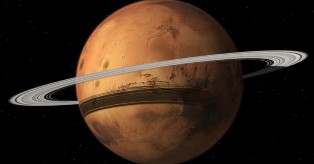
NEW YORK: Nothing lasts forever – especially Phobos, one of the two small moons orbiting Mars. The moonlet is spiraling closer and closer to the Red Planet on its way toward an inevitable collision with its host. But a new study suggests that pieces of Phobos will get a second life as a ring around the rocky planet.
In our solar system, the only planets with rings are the gas giants – Jupiter, Saturn, Uranus and Neptune. The study, published Monday in the journal Nature Geoscience, suggests this wasn’t always the case. However, the study authors say this is probably the last time a rocky planet will have a chance to sport a ring.


A moon – or moonlet – in orbit around a planet has three possible destinies. If it is just the right distance from its host, it will stay in orbit indefinitely. If it’s beyond that point of equilibrium, it will slowly drift away. (This is the situation with the moon; as it gradually pulls away from Earth, its orbit is growing by about 1.5 inches per year.) And if a moon starts out on the too-close side, its orbit will keep shrinking until it crashes into its host planet.
That will be the ultimate fate of Phobos, as astronomers have known for decades. But Benjamin Black and Tushar Mittal, both planetary scientists at UC Berkeley, wanted to get a clearer picture of what this end would look like.
A lot depends on what Phobos is made of. To find out, Black and Mittal compared spectral data from the small moon with data from other rocky objects. The closest match they found was with a class of meteorites known as CM carbonaceous chondrites – especially those that fell on Canada’s frozen Tagish Lake in January of 2000.
Such objects aren’t especially strong, the study authors wrote. Phobos has the added weakness of having a low density, which suggests it’s very porous, they noted.
Phobos also had the misfortune of getting slammed by a large object that left a roughly six-mile-wide crater, which covers nearly half of the moonlet’s diameter. That impact undermined the moon’s integrity even further.