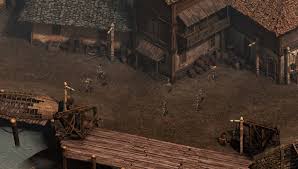
MELBOURNE: This might be the first game to utilize Pillars of Eternity’s setting, but you wouldn’t know it by the amount of world-building and lore that goes on here. Like Wasteland 2, Obsidian proves that world-builders and story-tellers can do some of their best work when freed from the shackles of voice-acting budgets and facial tech that doesn’t quite work and “cinematic” camera angles.
For those of us who grew up playing RPGs, there was one type of single-player RPG that often held a special place in our hearts. One that felt awesomely close to a tabletop RPG—filled with detailed text descriptions, visual and sensual cues, room for plenty of exploration, complex skill interactions, detailed character attributes, and a touch of humor in the best places. As you may have already guessed, I’m speaking of the D&D-like computer RPG, often known as the CRPG.
You might also like


Most fans of CRPGs found their way into the genre with games like the Zork series, Fallout, and Baldur’s Gate. These games gave headway to a myriad of party-based CRPGs that followed the same rulesets that tabletop RPGs tend to follow: Icewind Dale, Baldur’s Gate II, Arcanuum, Planescape: Torment, and more.
In 2012, Obsidian Entertainment, the same creators of Star Wars: Knights of the Old Republic 2, Neverwinter Nights 2, and South Park: The Stick of Truth, chose to bring Pillars of Eternity to life via Kickstarter. The single-player fantasy RPG saw a ton of support, raising over $4 million. There’s a certain power to nostalgia-filled gaming,it seems, and starting today, Pillars of Eternity is now available for purchase on Steam.
Pillars of Eternity, as one would hope, is very much in the same vein as Baldur’s Gate and other similar party-based CRPGs. Story is brought to the game’s forefront, along with customized party control, detailed character customization, and plenty of deep, immersion-filled tidbits that will keep many a CRPG fan content for a long while.
For many RPG fans, these games defined our love for deep roleplaying games that encouraged us to roleplay. To create a character with a unique history, backstory, and personality. To meet friends and foes alike with that persona in mind. To make decisions based off that persona.
Finding a random NPC out in the middle of a forest meant we’d have to weigh the pros and cons of taking him in and possibly pissing off the rest of our crew. Stumbling into a cozy inn raised an important question: Do I risk stealing shinies from that cabinet or do I play it safe? (Note: it’s always about the shinies.)
Today’s computer RPGs—and console RPGs for that matter—have been missing out on most of the above features and characteristics for a while now. Sure, they’ll have their snazzy cinematics, awesome voice acting, and twisting storylines that attempt to give players a choice as to their outcome. But thanks to that expensive voice acting and cinematics, today’s RPGs tend to dilute the roleplaying adventures of yore and the pure, simple experience that one generally associates with meeting your buddies over the weekend with a bag full of dice and a pile of papers.