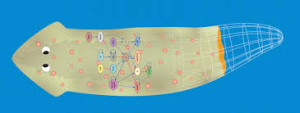
NEW YORK: An artificial intelligence system has for the first time reverse-engineered the regeneration mechanism of planaria–the small worms whose extraordinary power to regrow body parts has made them a research model in human regenerative medicine.
The discovery by Tufts University biologists presents the first model of regeneration discovered by a non-human intelligence and the first comprehensive model of planarian regeneration, which had eluded human scientists for over 100 years. The work, published in PLOS Computational Biology, demonstrates how “robot science” can help human scientists in the future.


To mine the fast-growing mountain of published experimental data in regeneration and developmental biology Lobo and Levin developed an algorithm that would use evolutionary computation to produce regulatory networks able to “evolve” to accurately predict the results of published laboratory experiments that the researchers entered into a database.
“Our goal was to identify a regulatory network that could be executed in every cell in a virtual worm so that the head-tail patterning outcomes of simulated experiments would match the published data,” Lobo said.