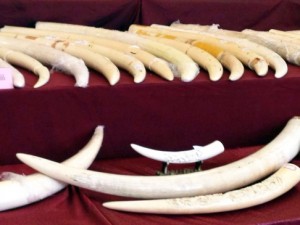
BANGKOK: Efforts by Thailand’s government to curb sales of ivory have been successful, following criticism of widespread trafficking in the country, police said Friday.
Police announced that since January, officials have seized only two elephant tusks and 422 tusk fragments, while in the same period last year they seized 99 tusks and 22 tusk fragments.


Deputy Police Commissioner Gen. Chalermkiat Sriworakhan said the drop in the number of cases showed that strict enforcement had deterred traffickers, even though there was just a minor drop in the weight of the seizures from last year’s half-year total of 398 kilograms (877 pounds) to 335 kilograms (797 pounds).
“We have made serious efforts to block elephant ivory from being smuggled into the country and sent on to another country,” Chalermkiat said, referring to past smuggling schemes. Now, “if they do get in the country, we do not let them leave,” he said.
“If we are able to block ivory from being smuggled out of the country then we will destroy it,” he said. “We have been able to effectively arrest more and more suspects with tangible results.”
Thailand had been considered to have the largest unregulated ivory market in the world and had been threatened with sanctions on the trade of protected wildlife species, but it introduced new laws and amendments in 2014 and 2015. The Elephant Ivory Act regulates the domestic ivory market and criminalizes the sale of African elephant ivory.
The wildlife trade monitoring network TRAFFIC praised Thailand for a large drop in sales of ivory items resulting from the crackdown aimed at shedding the country’s image as a center for the illicit trade in wildlife goods.
Its survey of Bangkok markets found a decline in the amount of ivory openly for sale from a high of 7,421 items in 2014 to 283 products in June 2016. Measured over a slightly longer period of time, the drop was even more dramatic. In December 2013 the number of ivory items openly on sale was 14,512, according to earlier surveys by TRAFFIC.
“Thailand’s legal reforms have paved the way for greater control of the domestic ivory market and it’s certainly something other countries in the region should emulate, especially Laos, Vietnam, and Myanmar,” Kanitha Krishnasamy, acting regional director for TRAFFIC in Southeast Asia, said in an email Friday. “Further to these efforts, it’s important also to test products in the market to ensure that no African elephant ivory is in the marketplace.”
Poachers have killed tens of thousands of African elephants for their tusks to meet demand for ivory in Asia, putting the species at great risk. Thailand became a major transit hub and destination for smuggled tusks, which are often carved into tourist trinkets and ornaments. The biggest demand comes from China.
Krishnasamy said illegal online trade is another part of the problem affecting Thailand.
“Monitoring and enforcement of trade taking place online is extremely crucial to make sure that ivory items not on sale in the physical market haven’t moved online,” she said.