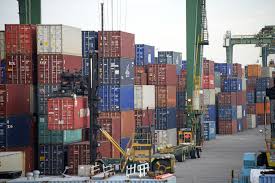
The downward revision Friday to U.S. gross domestic product was driven in part by the snarls at West Coast ports that began amid labor strife late last year and took a large toll on exports, economists said.
GDP shrank at a 0.7% seasonally adjusted annual rate in the first quarter, according to the Commerce Department, the result of harsh weather and a strong dollar that sapped demand for American-made goods. Exports declined 7.6% in the quarter, worse than the 7.2% that economists expected, and exports of goods fell by 14%, the most in six years.
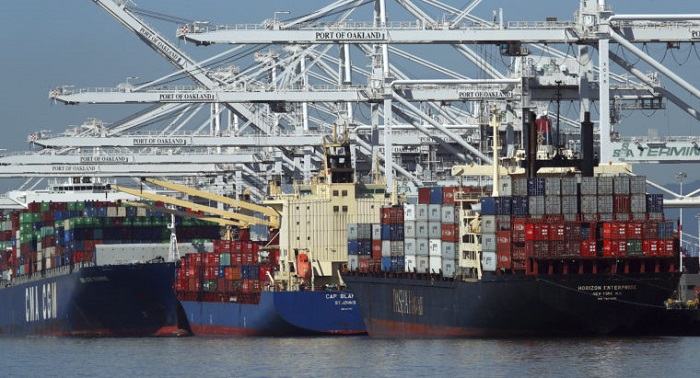

These numbers are reflected in data from West Coast ports. The combined ports of Seattle and Tacoma recorded a decline of 19.1% in exports of loaded shipping containers in the first three months of the year compared with the year-earlier period.
The Port of Long Beach reported that loaded outbound shipping container volume fell 16.3% in the first quarter compared with the first three months of 2014. In Los Angeles, the first-quarter decline was 5.3%, while at the Port of Oakland exports of full containers fell 21.7%.
The declines were the result of labor slowdowns at the ports as the International Longshore & Warehouse Union negotiated a contract with the port management. A new contract was ratified a week ago, but the backups at West Coast harbors took a big toll, according to Charles Clowdis, an economist with IHS Inc.
“The long lines at the L.A. and Long Beach harbors, with all those truckers waiting to get in, Oakland, Seattle, San Diego—all those ports got very congested, very quickly as L.A. and Long Beach got backed up,” Mr. Clowdis said.
“If you’re selling something overseas, and shipping something to the Far East, you couldn’t get your box off of the train, into the port and onto the ship.”‘The priority was on getting imports landed. Exports were a lower priority. ’
The backlogs rippled through the transportation chain, leading to delays for truckers, shortages of empty shipping containers that exporters use to fill with products to send overseas and, congestion at rail terminals. Some of the delays were so severe that frustrated foreign customers canceled orders.
“The congestion was severe enough that the priority was on getting imports landed, which is to say, getting the boxes off the ships and getting them loaded onto trucks. Exports were a lower priority,” said Paul Bingham, an economist with EDR Group, a Boston-based consultancy that focuses on transportation.
“It wasn’t just a matter of a shipment being delayed; it was that you lost the order,” said Mr. Bingham. “The congestion lasted long enough that you had customers overseas not making the orders. That’s what really hurt the exporters.”
Even with congestion cleared, he said, the strength of the U.S. dollar remains a concern for exporters. “U.S. exporters were less competitive, and that in and of itself was an impediment to exporters trying to compete overseas,” Mr. Bingham said. “And logistics can’t solve that problem.”