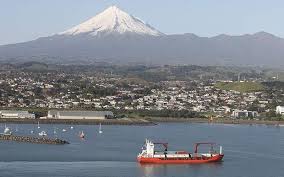
WASHINGTON: Port Taranaki’s profits fell 22 per cent to $8.9 million during the last financial year, new figures show. Bosses blame the 8.1 per cent trade dip on more demanding economic conditions compared to the previous year, when there was a strong oil and gas exploration programme off the Taranaki coast. But during the period ending June 30, 2016, volumes of exports, imports, bulk dry volumes and bulk liquids all fell, the port’s annual report says. Only logging showed an increase – up 71.2 per cent to 360,000 tonnes.
Revenue was down 10.6 per cent to $44.7m overall, but the port still returned a dividend of $4.48m to the Taranaki Regional Council – 10 per cent more than the previous year. Eight port directors also shared in $290,446 in payments, although this was down on the $299,970 paid out on 2015.

The port also cut costs by 3.1 per cent following a business review. This included the reduction of 11 jobs, although four new marine deckhand positions were created. “Revenue has fallen through a reduction of activity, particularly in oil and gas exploration, meaning third party costs and contracting work have reduced accordingly,” Port Taranaki chief executive Guy Roper said.
“A major component of Port Taranaki’s revenue is tied to the commodity markets of oil and gas, forestry and agriculture, and the port is feeling the effects of the reduction of offshore oil and gas exploration in the region.” The port’s container trade was hit hard by Fonterra’s decision to operate its own services from its New Plymouth cool store. This resulted in a 72.3 per cent fall in revenue in the container sector, compared to the previous year.
“Nationally, the container trade is going through change. We continue to watch developments closely and have the onshore equipment and expertise ready to recommence the service should the opportunity arise,” said Roper. But there was good news thanks to the booming log industry, which is so strong an area previously dedicated to containers was given over to storage in order to meet demand, Roper said.
“Along with logs, revenue gained from providing storage solutions for our customers has also helped to ease the impact of the downturn in oil and gas, and the loss of the container transfer facility. “Our ongoing focus is to free up Port Taranaki land to provide more storage options close to wharves for our customers. “This was the reason behind the purchase of the former power station site, which is now being used to store bulk dry goods.”
Bosses invested $15.3m in the port, of which $5.1m was spent buying the Omata tank farm. This has been refurbished and is now on a long-term lease with BP as part of a partnership that will see more motor spirits coming to the region through the port, resulting in fewer petrol tankers on the roads.
The port spent $2.1m on a second set of ShoreTension units, which will cut the number of vessels excluded from the port during long period waves – sets of 10-30 centimetre swells spaced out around 300 metres. These can create a pendulum-like rocking motion of a vessel, with the potential to cause mooring lines to snap.
Port Taranaki Chairman John Auld said the business would continue to be forward thinking, innovative and a responsible investor of capital in an increasingly competitive industry. “Profitability for the next financial year is expected to be at similar levels. “We will look to further explore development and growth, providing good customer service and utilising our assets to their full potential,” Auld said.