WASHINGTON: THE VOLUME of cargo passing through the country’s ports grew 4.15% year on year in the first quarter, the Philippine Ports Authority (PPA) reported, mainly due to increasing trade and the growing economy but tempered by the mining industry crackdown. PPA said in a statement on Tuesday that cargo volume for the first quarter of 2017 rose to 54.298 million metric tons (MMT), from 52.133 MT handled during the same period last year. PPA General Manager Jay Daniel R. Santiago said while the industry posted volume growth for the period, growth, however, slowed compared to the 8% posted a year earlier.
“Philippine cargo volume sustained its growth but on a slower pace for the first quarter of 2017 due to the significant drop in export volume. Critical developments clouding the mining industry have also affected the industry’s shipments in several ports nationwide,” the agency said in its statement. Foreign volumes during the period rose by 3.57%, accounting for 30.473 MMT, against the 29.422 MMT handled in the first three months of 2016 while domestic cargo saw a rise of 4.91% to 23.825 MMT. “The healthy economic performance explains the sustained robust operations of Philippine ports at large. While we posted volume growth for the period, the growth pace, however, is slower… the slower pace is due primarily to the overall decline in export cargo volume, which dropped 8% for the first quarter compared to last year,” Mr. Santiago said.
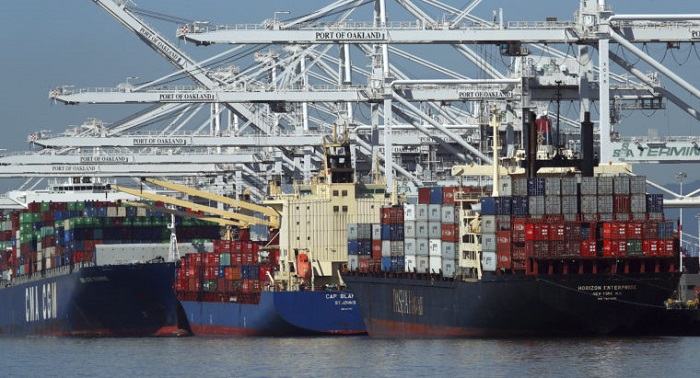

PPA said for the period, export volume was only at 9.04 MMT compared to the 9.78 MMT handled in the same period in 2016. Container volume, PPA said totaled 1.521 million twenty-foot equivalent units (TEUs), up 4.08%, with domestic boxes growing 7.71% to 638,435 TEUs while foreign boxes rose 1.61%. Boxes for export were the drag on growth, falling 5% to 408,018 TEUs. Among the ports that posted growth in TEU volume include NCR North, Davao, Batangas, South Harbor and the Manila International Container Terminal. Passenger traffic, on the other hand, maintained its upward trend with a 0.89% increase to 15.893 million. “The nominal growth was due to the change in the period of the Holy Week celebration while the reliance by the sea-traveling public on Roll on-Roll off (RoRo) vessels, fastcraft and motorized bancas as primary mode of transportation for domestic interisland connectivity remained the primary (factor for) passenger traffic,” PPA added. Vessel calls meanwhile fell by 1.59% to 103,499, with domestic vessels accounting for most of the decline.
PPA said the reduced vessel traffic was a “result of successive cancellation of trips due to inclement weather by the Philippine Coast Guard and the routine maintenance of passenger vessels that limited the number of trips.” Productivity, particularly at the Manila Ports that handled some 85% of the total cargo volume to and from the Philippines, remains healthy with a combined yard utilization of 55% with a berth occupancy rate of 61% and quay crane productivity of 25 moves an hour per crane. Despite pronouncements from the Department of Public Works and Highways it is doubling imports due to the various infrastructure developments being carried out by the government, PPA said it is “not expecting” that such development will drastically increase volume that will warrant another overhaul of the agency’s revised 2017 volume forecast. PPA earlier tempered its growth targets this year, expecting a “challenging 2017” where it expects “nominal growth” amid persistent volatility in the peso and reduced volume expected from miners. “Last year was a great year for the agency as we were able to post significant figures in terms of cargo volume and revenue. This year, however, will be different as we anticipate (growth) to be nominal due to several developments particularly in the mining industry, which has been one of our growth areas the past couple of years,” Mr. Santiago earlier said. “Based on our review, almost all our business aspects have reduced targets and budgets for 2017 ranging from the original 20% to only 3%,” he said.
PPA noted that its revised Corporate Operating Budget (COB) this year was reduced to P14.59 billion which is 2% higher than the 2016 COB with the biggest reductions in Port Dues, Berthing, Anchorage, Arrastre/Stevedoring, Pilotage, Wharfage for export, Roll on-Roll off (Ro-Ro) fees as well as non-traditional income sources. Revised Operating Expenses, on the other hand, rose to P16.22 billion this year from only P9.33 billion last year while total capital expenditure increased to P7.42 billion this year compared to the P3.50 billion in 2016 in order to implement several port projects that include the modernization of Mindanao and Visayas ports like Iloilo, General Santos, Cagayan de Oro and Zamboanga, improvement of all passenger terminal buildings, repair and maintenance projects and the implementation of 14 other projects. In 2016, the PPA posted a P6.159 billion net profit, beating its target by 165%. The result was also up 8% against the P5.705 billion registered in 2015 driven by increases in Ro-Ro fees, berthing fees and vessel lay-up fees. “While we expect this condition to be temporary, the authority is bracing for a challenging 2017,” Mr. Santiago earlier said. PPA has reported that the volume of cargo passing through the country’s ports rose 12% in 2016 to 249.567 million metric tons mainly due to increased trade associated with the growing economy.