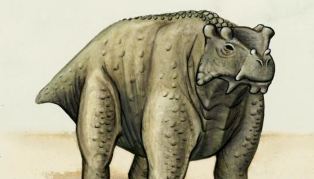


LONDON: It may be the earliest known creature to do so, according to a new study.Some 260 million years ago, the thinking went that most creatures were scampering around like lizards on the ancient supercontinent known as Pangea. However, pareiasaurs usually boasted limbs that extended from the side of the body, then curved downwards at the elbow.
Lead author of the new study, Morgan Turner, expected the pre-reptile Bunostegos akokanensis to be a sprawler too, but they learned about a different story from the bones of the animal’s forelimbs.
“Aspects of the anatomy of the shoulder and the forelimb indicate that the humerus could not have jutted out in a “sprawling” posture”, Dr. Linda Tsuji, contract assistant curator at the Royal Ontario Museum in Canada and a co-author of the study, told The Huffington Post in an email, “and in Bunostegos we see limited motion at the elbow joint, which is an indication of upright posture in other animals”.
Turner carried out the analysis under supervision of Professor Christian Sidor when he was a student at the University of Washington.Meanwhile Bunostegos’s humerus is not twisted like those of sprawlers.
It might be that Bunostegos akokanensis was quite a sight, what with its oversized body and its bony armor, but it’s not its looks that paleontologists are quite fascinated with. Standing like a cow, and about the same size.
Then there is the elbow joint. Rather, it would function like a human knee, back and forth. First, the shoulder joint faces downwards, which means the connecting humerus would be vertically oriented underneath.

Karachi Port sets 138-year cargo handling record
KARACHI: Pakistan's maritime sector has achieved a major milestone as Karachi Port set a new record in its 138-year history...