
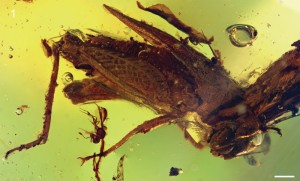


CANADA: Researchers recently took a close look at a 100 million year old cockroach specimen preserved in beautiful, transparent amber, and they are saying that it is part of a new family of long-extinct night-hunting cockroaches that were not all that different from today’s praying mantids.
So what makes this ancient bug different from the modern roach? For one, the specimen, which was discovered at a mine in Noije Bum, Myanmar, boasts a long neck that allowed it to freely rotate it’s head. Comparatively, the modern roach cannot so easily swivel its noggin, usually only needing to lower its flat head in a vertical motion in order to feed.
The prehistoric roach also had long and spindly legs, much like many predatory insects today. According to a brief paper recently published in the journal Geologica Carpathica, an analyses of the ancient specimen suggests that it was a predatory insect, likely pursuing prey at night. Conversely today’s roach, while largely nocturnal, ceartainly isn’t out for blood. Instead the modern cockroach can be found scavenging from food, looking for anything from sweets to even hair, moldering books, and other decaying matter.
According to Peter Vršanský from the Geological Institute in Bratislava, Slovakia, and Günter Bechly from the State Museum of Natural History in Stuttgart, Germany, who examined the insect, the specimen comes from the early Cretaceous period, from whence several predatory cockroach-like lineages evolved.
Today, only one of those lineages remain – the praying mantis. Modern mantids have similar legs for careful pursuit, and are actually close cousins to the cockroach, despite how differently they look.

Karachi Port sets 138-year cargo handling record
KARACHI: Pakistan's maritime sector has achieved a major milestone as Karachi Port set a new record in its 138-year history...

