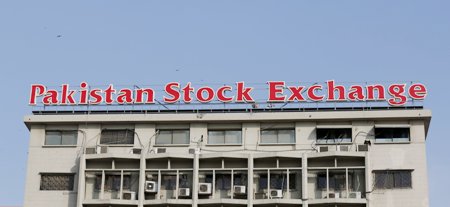
KARACHI: Pakistan Stock Exchange (PSX) witnessed a negative trend on Wednesday as the benchmark KSE-100 index lost 264.03 points and slipped to 31,565.21 points.
The recent simmering tensions between nuclear-armed Pakistan and India over Kashmir dispute had pushed investors to adopt cautious behaviour in the trading.


Moreover, since the passage of the financial budget for the fiscal year 2019-20, the stringent policies had been reflecting themselves in the downfall of the stock market.
Meanwhile, according Asian Development Outlook Update (ADOU) 2019, Pakistan’s economy in fiscal year (FY) 2019, which ended on 30 June, is showing signs of recovery as the government’s fiscal consolidation and austerity measures to address the structural weaknesses started to take effect. However, the growth rate moderated to 3.3% during the period reflecting persistent macroeconomic imbalances and heightened external challenges.
The update of the Asian Development Bank’s (ADB) flagship annual economic publication noted the current account deficit eased from 6.3% of gross domestic product (GDP) in FY2018 to 4.8% in FY2019.
The trade deficit narrowed by almost 11.5% to $28.2 billion as rupee depreciation drove down merchandise imports by 7.4%, particularly for goods other than petroleum. Despite currency depreciation in real effective terms, merchandise exports declined by 2.2%, partly because low cotton production constrained textile exports. Workers’ remittances stirred from 3 years of near stagnation to grow by 9.7%, lending support to the current account.
Pakistan has done well in stabilizing the economy in face of strong challenges by taming the spiraling current account deficits and export bill and through robust implementation of reforms to improve governance and rejuvenating country’s competitiveness,” said Xiaohong Yang, ADB Country Director for Pakistan.
“Pakistan need to press ahead with macroeconomic and structural reforms; revitalizing public sector enterprises; improving revenue collection, energy and water security, and leveraging improved security and regional cooperation opportunities, to secure the hard won gains and promote growth.”
The financial account surplus narrowed considerably in FY2019, by 16.2%, the $2.3 billion fall mostly accounted for by $1.8 billion less in foreign direct investment owing in part to policy uncertainty but also to the winding down of energy and infrastructure projects in the China–Pakistan Economic Corridor.
However, notwithstanding large bilateral financing received from the People’s Republic of China, Saudi Arabia, and the United Arab Emirates, gross foreign exchange reserves fell by $2.5 billion to $7.3 billion at the end of June 2019, or cover for 1.7 months of imports, noted the report.
Other notable challenges included 24 percent depreciation of Pakistan rupees against the US dollar FY2019 as the authorities moved toward the adoption of a flexible exchange rate determined by the market, after having defended an overvalued rupee in recent years. Inflation trended substantially higher, from an average of 3.9% in FY2018 to 7.3% in FY2019, mainly reflecting currency depreciation and a considerable increase in domestic fuel prices.
Average food inflation reached 4.6%, partly because of the poor harvest, and nonfood inflation accelerated to 9.2%. To keep policy rate positive in real terms, the State Bank of Pakistan, the central bank, raised its policy rate by a cumulative 575 basis points to 12.25% at the end of FY2019, and by another 100 basis points to 13.25% in July 2019.