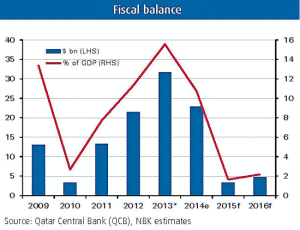
DOHA: Qatar’s elevated government spending and declining revenues are expected to narrow the country’s fiscal surplus from 10.8 percent of gross domestic product (GDP) in 2014 to 2.2 percent of GDP by 2016. This is primarily due to the decline in energy prices, with hydrocarbon receipts likely to drop by 33 percent in 2015.
However, economic growth is to remain robust on account of burgeoning non-hydrocarbon sector activity. Driven by government spending on the country’s $210bn development plan, the non-hydrocarbon sector will continue to be the driver of economic growth.
NBK’s latest economic outlook on Qatar noted the project and corporate activity in the country is buoyant, which should help state coffers with greater revenues from taxes. On the expenditures side, fiscal consolidation should be expected. However, the authorities will no doubt be constrained by their commitment to the development plan and to diversifying the country’s economic base-something which may take on even greater urgency in view of the oil price decline.
Qatar’s current account surplus, which, as a percentage of GDP, has been in double-digits since 2010, is forecast to narrow to 4.4 percent of GDP in 2015 and 3.1 percent of GDP in 2016, respectively. Slowing export growth has already negatively impacted the country’s international reserves, which at $39.1bn in April, were still down by 11.7 percent from their 2014 peak of $46.1bn last November. Having said that, April was the second month in succession that reserve levels had increased in line with improving energy prices. On a year-on-year basis, reserve growth was now in positive territory after three months of contraction, increasing by 0.4 percent y-o-y.
Qatar’s real GDP growth is forecast to remain strong at 6.5 percent per annum over the next two years due to continued expansion of the country’s non-hydrocarbon sector. The decline in energy prices of 42.2 percent for oil (Brent) and 31.6 percent for natural gas since June 2014 should not materially impact growth in the short-to-medium term, though it may lead to a re-prioritisation of capital projects.
Output gains from the non-hydrocarbon sector are expected to be broad-based, with construction, financial and government services, and trade and hospitality leading the way with growth of above 10 percent y/y based, with construction, financial and government services, and trade and hospitality leading the way with growth of above 10 percent y/y.
According to NBK analysts, central to Qatar’s economic outlook is execution of the government’s 5-year, $210bn infrastructure development plan, which is expected to proceed in spite of the decline in
energy prices. $29bn worth of contracts were awarded in 2014 — 30 percent more than in 2013 — and they expect momentum to further increase in 2015 on the back of the $13bn worth of contracts for strategic projects awarded in Q1,15.
Inflation is projected to rise gradually, with rental inflation restrained by softer food and commodity prices. Headline inflation is expected to rise gradually over the forecast period, from an expected 2.1 percent in 2015 to 2.6 percent in 2016.
On the banking sector, the research note said Qatar banks’ credit to the public sector has been contracting and lending to the private sector has been accelerating over the last year.
The most recent data showed overall bank credit expanding by 12.1 percent y/y in April, with credit to the public sector contracting by 9.6 percent y/y. The public sector’s share of total credit has dropped to 37 percent, having been as high as 46 percent in November 2012.