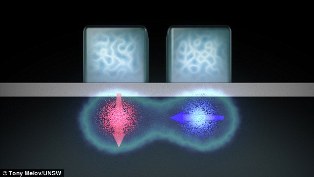
LONDON: For the first time, Australian engineers have demonstrated that they can write and manipulate the quantum version of computer code on a silicon microchip. This was done by entangling two quantum bits with the highest accuracy ever recorded, and it means that we can now start to program for the super-powerful quantum computers of the future.
Engineers code regular computers using traditional bits, which can be in one of two states: 1 or 0. Together, two bits create code words that can be used to program complex instructions. But in quantum computing language there’s also the possibility for bits to be in superposition, which means they can be 1 and 0 at the same time. This opens up a vastly more powerful programming language, but until now researchers haven’t been able to figure out how to write it.


Now engineers from the University of New South Wales (UNSW) in Australia have demonstrated that not only can they do this, but they can do it on silicon microchips very similar to the ones that make up today’s computers, which means the technology will be easy and quick to scale up.
So how exactly do you write quantum code? It all comes down to a phenomenon known as quantum entanglement. When two particles are entangled, it basically means that the measurement of one of them will instantly affect the state of its entangled particle, even if it’s thousands of kilometres away.
“This effect is famous for puzzling some of the deepest thinkers in the field, including Albert Einstein, who called it ‘spooky action at a distance’,” said lead researcher Andrea Morello, from the Centre for Quantum Computation and Communication Technology at UNSW. “Einstein was sceptical about entanglement, because it appears to contradict the principles of ‘locality’, which means that objects cannot be instantly influenced from a distance.”
But entanglement has been demonstrated time and time again through something by something known as Bell’s test, which requires engineers to violate Bell’s Inequality Principle. Basically, Bell’s Inequality Principle sets a limit for the amount of correlation there can be between two classical bits – anything above that must be quantum entangled.