

Customs Today
  • Home
  • Islamabad
  • Karachi
  • Lahore
  • National
  • Transfers and Postings
  • Chambers & Associations
  • Business
No Result
View All Result
Customs Today
  • Home
  • Islamabad
  • Karachi
  • Lahore
  • National
  • Transfers and Postings
  • Chambers & Associations
  • Business
No Result
View All Result
Customs Today
No Result
View All Result
Home Science & Technology Science

Quasar activity in the early universe is driven by galaxies colliding

byCustoms Today Report
25/06/2015
in Science, Science & Technology
Share on FacebookShare on Twitter

You might also like

Tesla driverless system to use updated radar technology

12/09/2016

Apple to develop its own self-driving technology

10/09/2016

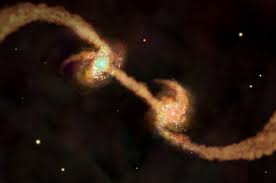
FRANCE: By using Hubble Space Telescopes infrared vision, astronomers have uncovered the mysterious early formative years of quasars, the brightest objects in the universe.
Hubble’s sharp images unveil the chaotic collisions of galaxies that fuel quasars by feeding supermassive central black holes with gas.
“The Hubble observations are definitely telling us that the peak of quasar activity in the early universe is driven by galaxies colliding and then merging together,” said Eilat Glikman of the Middlebury College in Vermont, US.
“We are seeing the quasars in their teenage years, when they are growing quickly and all messed up,” Mr. Glikman noted.
Discovered in the 1960s, a quasar, contraction of “quasi-stellar object,” pours out the light of as much as one trillion stars from a region of space smaller than our solar system.
The source of the light is a gusher of energy coming from supermassive black holes inside the cores of very distant galaxies.
“The new images capture the transitional phase in the merger-driven black hole scenario,” he noted.
“We’ve been trying to understand why galaxies start feeding their central black holes, and galaxy collisions are one leading hypothesis. These observations show that the brightest quasars in the universe really do live in merging galaxies,” said co-investigator Kevin Schawinski of the Swiss Federal Institute of Technology Zurich.
The overwhelming glow of the quasar drowns out the light of the accompanying galaxy, making the signs of mergers difficult to see.

Related Stories

Tesla driverless system to use updated radar technology

byCT Report
12/09/2016

WASHINGTON: Electric carmaker Tesla announced Sunday it was upgrading its Autopilot software to use more advanced radar technology. In a...

Apple to develop its own self-driving technology

byCT Report
10/09/2016

SAN FRANCISCO: Apple may not become an automaker, but it still wants to develop its own self-driving technology. The iPhone-maker's...

NASA spots slowest known magnetar

byCT Report
10/09/2016

WASHINGTON: Astronomers have found evidence of a magnetar - magnetised neutron star - that spins much slower than the slowest...

‘YouTubers’ outshining old-school television

byCT Report
09/08/2016

SAN FRANCISCO: A media revolution is taking place, and most people over 35 years of age aren’t tuned in. Millennial...

Next Post

Economic recovery

  • Terms and Conditions
  • Disclaimer

© 2011 Customs Today -World's first newspaper on customs. Customs Today.

No Result
View All Result
  • Transfers and Postings
  • Latest News
  • Karachi
  • Islamabad
  • Lahore
  • National
  • Chambers & Associations
  • Business
  • About Us

© 2011 Customs Today -World's first newspaper on customs. Customs Today.