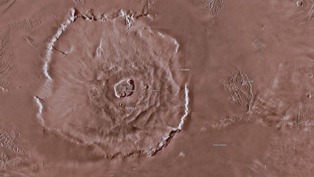


Rounded pebbles discovered by the Curiosity rover were carried some 30 kilometres from their source by a flowing river on the red planet, a new study concludes.
The research, reported in the journal Nature Communications, provides some of the most compelling evidence yet that Mars had long periods of warm climate, allowing flowing rivers to move material tens of kilometres downstream.
The findings are based on new experiments that show the shape of a pebble can be used to accurately determine how far it has been transported across a planet’s surface.
“The thing that’s absolutely remarkable is that we can make observations from space, send a rover there, and by looking at individual particles, actually determine — from their shapes — how far they’ve moved,” said one of the study’s authors, Professor Douglas Jerolmack of the University of Pennsylvania in Philadelphia.
Scientists were trying to find the origin of rounded pebbles observed in sedimentary deposits by NASA’s Curiosity rover near its Gale Crater landing site on a alluvial fan known as Bradbury Rise.
The sedimentary deposits contained rounded particles, millimetres to centimetres in diameter, that were mixed with sand to form conglomerates.

Karachi Port sets 138-year cargo handling record
KARACHI: Pakistan's maritime sector has achieved a major milestone as Karachi Port set a new record in its 138-year history...