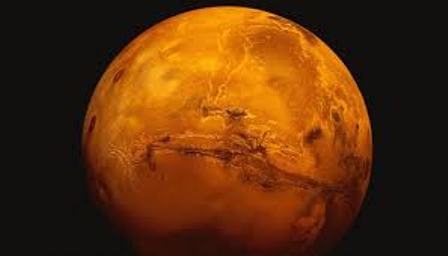
HONG KONG: Scientists believe Mars may once have had a warmer and wetter environment, suggesting that an atmosphere thicker Earth’s may have once shrouded the planet.
The Red Planet’s current atmosphere is thin and wispy and mostly comprised of carbon dioxide. But this begs the question: where did Mars’ carbon go?


A team of experts from California Institute of Technology (Caltech) and NASA’s Jet Propulsion Laboratory (JPL) believe that they might have an answer to this question, writes Tech Times.
According to scientists, a moderately dense atmosphere may have surrounded the Red Planet 3.8 billion years ago. However, a photochemical process is believed to have helped this atmosphere to dissipate without causing the carbon to disappear completely. This explanation is consistent with current carbon isotopic measurements.
“With this new mechanism, everything that we know about the Martian atmosphere can now be pieced together into a consistent picture of its evolution,” Renyu Hu, the study’s lead author, said in a press release.
Researchers believe two mechanisms are responsible for the removal of excess carbon dioxide from the planets atmosphere. According to the first theory, excess CO2 was absorbed into the minerals in rocks known as carbonates. The second explanation describes how the CO2 disappeared into space.
The scientists in the current study decided to examine the ratio of carbon-12 and carbon-13 isotopes present on Mars to see if they provided an explanation for the Red Planet’s missing carbon. The isotopes are sensitive to changes in their environment, meaning they could hold important clues into the evolution of the Martian atmosphere.
After taking the measurements from carbon isotopes found in Martian meteorites containing gases originating deep within Mars’ mantle, the researchers analyzed the ratio of isotopes contained within the planet’s early atmosphere.
The team compared these measurements with current measurements collected by NASA’s Curiosity rover. Their results showed that the Martian atmosphere showed an unusual abundance of carbon-13.
However, a prior study on carbonates present on Mars showed that the planet’s upper crust did not contain enough carbonates to account for all the missing carbon that would have been present in its atmosphere.