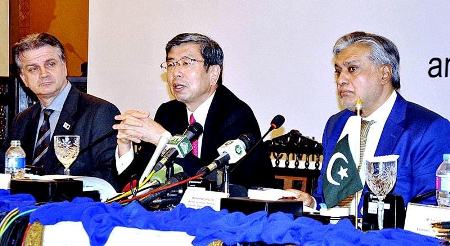
YOKOHAMA, Japan: Identifying major Bank’s future priorities, mainly infrastructure development, President Asian Development Bank, Takehito Nakao said Saturday the region will require $1.7 trillion per year in investments in power, transport, telecommunications, and water through 2030.
In his speech at the Annual Meeting of ADB Board of Governors here, Takehito Nakao said “this is more than double our previous estimate, reflecting additional investments, needed to support continued growth and address climate change.” Listing five chief priorities of the Bank, the ADB President said supporting infrastructure development will remain priority. In this regard “we will incorporate more advanced technologies. Our developing member countries care about maintenance costs and the resilience of infrastructure,” he added.


He said member countries increasingly aspire for innovative technologies for their projects. And many innovative companies across the world, including in emerging economies, are keen to contribute to Asia’s development. “We have already initiated reforms in our business processes for project preparation and procurement to promote greater use of advanced technologies,” he added.
Social sectors being another priority, he said in health, bank will support universal healthcare systems and cross-border initiatives to combat communicable diseases such as malaria, tuberculosis, and HIV.
While in education, ADB will continue to support Technical and Vocational Education and Training, or TVET, and help improve the quality of secondary education.
“We will further promote gender equality. Gender has been a key area of ADB operations for many years, even before we adopted our first Policy on the Role of Women in Development in 1985,” he said adding, gender is a cross-cutting issue that influences all social and economic processes. “We will design projects that help women and girls secure higher skills, better health, more jobs, and a larger voice in decision making.”
Next priority area includes ADB efforts to mobilize private resources for development besides promoting greater and more effective use of public-private partnerships, or PPPs, he said. In addition, ADB is directly financing private companies in such infrastructure as solar, wind and geothermal power, highways, telecommunications, and ports. And ADB is supporting an increasing number of private sector projects in education, health, and agriculture. Funding micro, small, and medium sized enterprises, through local banks, will remain a priority, the President observed. Regarding ADB’s private sector operations, he said “I very much appreciate Japan’s contribution to the newly created trust fund called Leading Asia’s Private Infrastructure, or LEAP fund.”
It is based on an equity investment of up to $1.5 billion from JICA (Japan International Cooperation Agency), and it supports ADB’s lending and equity investments in private infrastructure projects. “In 2016, only five months after it was set up, we approved two clean energy projects, in India and Indonesia, using this trust fund and ADB’s own resources”, he added.
Another priority for Strategy 2030 will be continued reforms in ADB itself. ADB will strengthen its sector and thematic expertise, enhance staff capacity, and streamline procedures, he said. “We will deepen our collaboration with civil society, academia, the private sector, and local authorities such as Yokohama.”