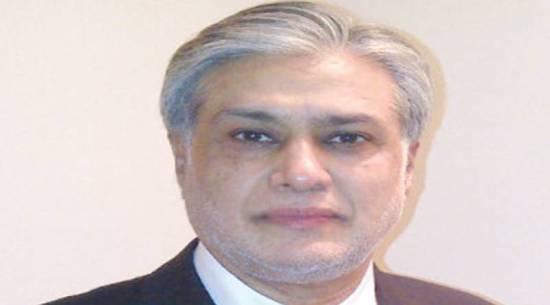
ISLAMABAD: Finance Minister Ishaq Dar has declared the new budget for the upcoming fiscal year 2016-17 as growth-oriented. He said it is a historic day for the agriculture sector as the budget envisages extensive relief and incentives for farmers.
He said that gross revenue receipts of the federal government for the next financial year are estimated at Rs 4,915 billion as compared to Rs 4,332 billion during the outgoing year, showing an increase of 13.5 percent.

Explaining the federal budget in the National Assembly, the finance minister said that the share of the provincial governments out of the taxes would be Rs 2,136 billion as compared to Rs 1,852 billion for the outgoing year.
It shows an increase of about 14.3 percent. He said that the net resources left with the federal government will be Rs 2,781 billion as compared to revised estimates of Rs 2,481 billion for the outgoing year.
The expenditure is estimated at Rs 3,400 billion for the next year against revised estimate of Rs 3,282 billion for the current financial year. The defense budget is being increased from existing Rs 776 billion to Rs 860 billion for the next year, showing an increase of about 11 percent. An allocation of Rs 68 billion has been made for 13 projects for development of Gwadar while Rs 41 billion is earmarked for modernization of Pakistan Railways.
The Higher Education Commission has been allocated Rs 21 billion for its 167 projects during next year. Separate funds for the laptop project and Afghans scholarship scheme have been provided outside the PSDP.
Important initiatives in the next year include scholarship schemes for training of faculty, infrastructure of development of universities, implementing the 10,000 PhDs scholarship scheme, providing higher education access at district level and setting up skill universities.
Pakistan Atomic Energy Commission will receive Rs 27.56 billion. PAEC allocation includes over Rs 22 billion for Chashma Nuclear Power Projects C-III and C-IV.
The budget also envisages Rs 7 billion for ERRA and Rs 20 billion for Sustainable Development Goals and Community Development Programme.
About Rs 25 billion have been allocated in the budget for various health programmes, including immunization, family planning, Prime Minister’s National Health Insurance and the proposed cancer hospital in Islamabad.
The finance minister announced tax relief and growth measures for different sectors of the economy. He announced ten percent ad-hoc relief allowance on running basic pay to all federal government employees with effect from the first of next month. Ad-hoc increases of 2013 and 2014 will be merged in the pay scales.
There will be ten percent increase in net pension to all pensioners of federal government. Twenty-five percent increases in net pension to all pensioners of federal government above eighty-five years of age will be given.
Special area compensatory allowance at the uniform rate of three hundred per month will be given to civil armed forces posted in border areas while special conveyance allowance to disabled employees would be given at the rate of Rs 1,000 per month.
There is also an increase in integrated allowance to naib qasids and daftaries, revision of outfit allowance to Pak army officers, revision of late sitting conveyance charges, washing allowance , M. Phil allowance, additional charge allowance and current charge special pay.
The finance minister announced up-gradation of the post of LDC from basic scale seven to nine, UDC from nine to eleven; assistant from 14 to 16 and assistant incharge from BS-15 to 16. Posts of khateebs have been upgraded from BS-12 to fifteen, moazzan from 5 to seven and khadim BS-5 to 6.
On the pattern of increase in the pay of government employees, the minimum wage of labour has also been increased from Rs13000 to Rs14000 per month.
In order to promote information technology, sales tax is being exempted on import of laptops and PCs. Sales tax rate on second hand clothing is being reduced from existing ten to eight percent.
Sixteen percent federal excise duty on services like advertisement on CCTV and cable TV, shipping agents, banking companies, insurance companies, cooperative financing societies, modarabas, musharakas, forex dealers and stock brokers is being withdrawn where provincial sales tax is payable.
Enumerating the salient features of media term micro framework 2016-19, the finance minister said that GDP growth rate will be enhanced to seven percent in the next three years.
He said inflation rate will be kept at single digit while investment to GDP ratio will be enhanced to 21 percent. He said that fiscal deficit will be brought down to 3.5 percent while tax to GDP ratio will be enhanced to 14 percent.
Ishaq Dar said that foreign exchange reserves will be pushed up thirty billion dollars. He said given the economic performance last three years, this micro-economic framework is very much implementable.
He said that the government has also chalked out a comprehensive plan to encourage private investment in different sectors including transport and infrastructure. He said similarly, foreign direct investment will be facilitated which will help enhance the economic activity in the country. He said our plan also envisages establishment special economic zones which will create job opportunities for youths.
Ishaq Dar said promotion of health and education as well as poverty alleviation and women empowerment are the main targets of the Public Sector Development Programme. He said the government is also giving priority to the construction of small dams especially in Balochistan and Khyber Pakhtunkhwa province.
The finance minister also announced a series of measures for the provision of telecommunication and internet facilities in the far flung areas of the country. The budget envisages that capital gain on disposal of immovable properties be taxed at a rate of ten percent if the property is sold within five years of acquisition.
It has been proposed to increase the rate of withholding tax in case of sale of property from zero point five percent to one percent for filers and from one percent to two percent for non-filers. In case of purchase of property, the rate is being increased from one to two percent for filers and from two to four percent for non-filers.
The rate of withholding tax for services by print and electronic media is being enhanced from one percent to one point five percent and this will be treated as final tax in respect of income from these receipts.
The rate of withholding tax for commercial bills of electricity above Rs 20,000 is being increased from existing 10 percent to 12 percent. There will be no change for industrial consumers.
The budgetary proposals envisage that an adjustable withholding tax at the rate of three percent of the value of vehicle be collected by every bank or leasing company from non-filers at the time of lease. Withholding tax rate for non-filers is being increased from fifteen to twenty percent on winning of prize bonds.
The finance minister pointed that zero rating of stationery items is open to misuse and announced withdrawal of the facility. Similarly, he proposed that zero rating on preparations for infant use milk may be retained while zero rating on milk and fat filled milk sold in rettail packing is withdrawn.
Ishaq Dar said the rate federal excise duty on cement at the rate of five percent of the retail price is being replaced with fix rate basis at the rate of one rupee per kilogram.
The existing sales tax rate on mobile phones is being increased from the existing Rs 500 to Rs 1,000 and from Rs 1,000 to Rs 1,500. The rate of tax on low category mobile will remain unchanged at R s300.
The minister also announced increase in tax rate of about twenty-three paisa per cigarette for lower tier cigarettes and fifty five paisa per cigarette for higher tier cigarettes. The rate of federal excise duty on aerated waters is being increased from the existing ten point five percent to eleven point five percent.
He announced reduction of tariff slabs from five to four. The new general slabs will be three percent, eleven percent, sixteen percent and twenty percent. From next year the two percent and five percent slabs will be merged in the new slab of three percent.