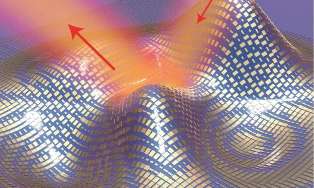
WASHINGTON: Invisibility cloaks are a staple of science fiction and fantasy, from Star Trek to Harry Potter, but don’t exist in real life, or do they? Scientists at the U.S. Department of Energy (DOE)’s Lawrence Berkeley National Laboratory (Berkeley Lab) and the University of California (UC) Berkeley have devised an ultra-thin invisibility “skin” cloak that can conform to the shape of an object and conceal it from detection with visible light. Although this cloak is only microscopic in size, the principles behind the technology should enable it to be scaled-up to conceal macroscopic items as well.
Working with brick-like blocks of gold nanoantennas, the Berkeley researchers fashioned a “skin cloak” barely 80 nanometers in thickness, that was wrapped around a three-dimensional object about the size of a few biological cells and arbitrarily shaped with multiple bumps and dents. The surface of the skin cloak was meta-engineered to reroute reflected light waves so that the object was rendered invisible to optical detection when the cloak is activated.


“This is the first time a 3D object of arbitrary shape has been cloaked from visible light,” said Xiang Zhang, director of Berkeley Lab’s Materials Sciences Division and a world authority on metamaterials – artificial nanostructures engineered with electromagnetic properties not found in nature. “Our ultra-thin cloak now looks like a coat. It is easy to design and implement, and is potentially scalable for hiding macroscopic objects.”
Zhang, who holds the Ernest S. Kuh Endowed Chair at UC Berkeley and is a member of the Kavli Energy NanoSciences Institute at Berkeley (Kavli ENSI), is the corresponding author of a paper describing this research in Science. The paper is titled “An Ultra-Thin Invisibility Skin Cloak for Visible Light.” Xingjie Ni and Zi Jing Wong are the lead authors. Other co-authors are Michael Mrejen and Yuan Wang.
It is the scattering of light – be it visible, infrared, X-ray, etc., – from its interaction with matter that enables us to detect and observe objects. The rules that govern these interactions in natural materials can be circumvented in metamaterials whose optical properties arise from their physical structure rather than their chemical composition. For the past ten years, Zhang and his research group have been pushing the boundaries of how light interacts with metamaterials, managing to curve the path of light or bend it backwards, phenomena not seen in natural materials, and to render objects optically undetectable. In the past, their metamaterial-based optical carpet cloaks were bulky and hard to scale-up, and entailed a phase difference between the cloaked region and the surrounding background that made the cloak itself detectable – though what it concealed was not.