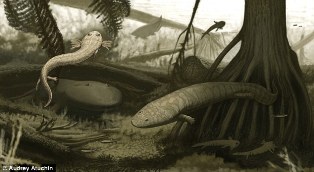
HARROW: With the help of ancient fossils unearthed in northeastern Brazil, an international team of paleontologists has identified several amphibian species and a reptile that lived 278 million years ago (middle Permian epoch) in tropical lakes of the western part of the supercontinent Gondwana.
“Almost all of our knowledge about land animals from this time, comes from a handful of regions in North America and western Europe, which were located near the equator. Now we finally have information about what kinds of animals were present in areas farther to the south, and their similarities and differences to the animals living near the equator,” said Dr Kenneth Angielczyk from the Field Museum of Natural History, a team member and a co-author of a paper in the journal Nature Communications.


In the paper, Dr Angielczyk and his colleagues from the United States, Germany, Argentina, Brazil, South Africa, and the UK, described two new species of ancient carnivorous amphibians called dvinosaurs (Dvinosauria).
One of the new dvinosaur species, Timonya annae, was a small, fully aquatic amphibian with fangs and gills, looking something like a cross between a modern Mexican salamander and an eel.
The other new species is Procuhy nazarienis, an amphibian whose name in the Timbira language of its Brazilian homeland means ‘fire frog.’
In the same region as where the fossils of Timonya annae and Procuhy nazarienis were uncovered, the palenontologists also discovered fossils of Captorhinus aguti (a small, herbivorous lizard-like reptile that until now has only been found far away in North America) and a collie-sized amphibian whose closest relatives lived in later times in southern Africa.