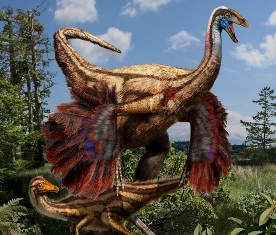
HONG KONG: Researchers in Canada have discovered fossilised remains of an ostrich-like dinosaur with preserved tail feathers and soft tissue, a finding that throws more light on the linkages between dinosaurs and modern birds. The discovery is shedding light on the convergent evolution of these dinosaurs with ostriches and emus relating to thermoregulation, researchers said.
“We now know what the plumage looked like on the tail, and that from the mid-femur down, it had bare skin,” said Aaron van der Reest, University of Alberta undergraduate paleontology student. This is the first report of such preserved skin forming a web from the femoral shaft to the abdomen, never before seen in non-avian dinosaurs. “Ostriches use bare skin to thermoregulate. Because the plumage on this specimen is virtually identical to that of an ostrich, we can infer that Ornithomimus was likely doing the same thing, using feathered regions on their body to maintain body temperature. It would’ve looked a lot like an ostrich,” said van der Reest.


“In fact, this group of animals – referred to as ornithomimids – is commonly referred to as “ostrich mimics,” he said. Although the preserved feathers are extremely crushed due to sediment compaction, scanning electron microscopy shows a three-dimensional keratin structure to the feathers on the tail and body. This new specimen – one of only three feathered Ornithomimus specimens in the world – is shedding light on the animal’s evolutionary adaptation to different environments.