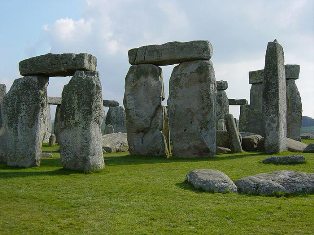


WASHINGTON: Stonehenge, the world-renowned circle of stone columns in southern England, may have had a brother. A much bigger, older brother.
University of Bradford researchers announced Monday that they had discovered a monument of about 100 stones covering several acres thought to have been built around 4,500 years ago.
The Stonehenge Hidden Landscapes Project used remote-sensing technologies to discover the monument, which is near Durrington Walls, also known as “superhenge.” Stonehenge, which is believed to have been completed 3,500 years ago, is about 2 miles away.
“What we are starting to see is the largest surviving stone monument, preserved underneath a bank, that has ever been discovered in Britain and possibly in Europe,” Vince Gaffney, an archaeologist at Bradford University who leads the project, toldThe Guardian newspaper. “This is archaeology on steroids.”
The evidence was found beneath 3 feet of earth. Some of the stones are thought to have stood 15 feet tall before they were toppled.
“Our high-resolution ground-penetrating radar data has revealed an amazing row of up to 90 standing stones, a number of which have survived after being pushed over, and a massive bank placed over the stones,” professor Wolfgang Neubauer, director of the Ludwig Boltzmann Institute for Archaeological Prospection and Virtual Archaeology, told CNN.

Karachi Port sets 138-year cargo handling record
KARACHI: Pakistan's maritime sector has achieved a major milestone as Karachi Port set a new record in its 138-year history...