Customs Today
  • Home
  • Islamabad
  • Karachi
  • Lahore
  • National
  • Transfers and Postings
  • Chambers & Associations
  • Business
No Result
View All Result
Customs Today
  • Home
  • Islamabad
  • Karachi
  • Lahore
  • National
  • Transfers and Postings
  • Chambers & Associations
  • Business
No Result
View All Result
Customs Today
No Result
View All Result
Home Science & Technology Science

Researchers found way to produce bubbles that sync with Beethoven’s popular “Symphony

byCustoms Today Report
04/11/2015
in Science, Science & Technology
Share on FacebookShare on Twitter

WASHINGTON: If you thought blowing bubbles brings you joy, wait to you see bubbles form from Beethoven’s “Ode to Joy.”

Researchers from the Massachusetts Institute of Technology have found a way to produce bubbles that are in sync with Beethoven’s popular “Symphony No. 9: Ode to Joy.”


You might also like

Tesla driverless system to use updated radar technology

12/09/2016

Apple to develop its own self-driving technology

10/09/2016

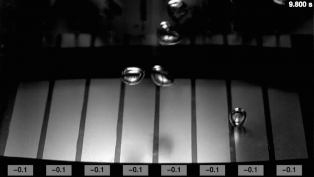
While the performance—called “Ode to Bubbles”—is impressive in itself, there is actually some real science behind the musical bubbles. The researchers developed a new method of turning bubbles on and off on demand in under less than a second when they form on a boiling surface.

MIT Researchers H. Jeremy Cho, Jordan P. Mizerak, and Evelyn N. Wang from the Department of Mechanical Engineering have discovered the method of controlling bubble formation, publishing their research in a recent issue of Nature Communications.

The researchers added a small amount of charged particles to water in a container that has a silver foil surface at its bottom at its boiling point, applying a weak voltage that sparked bubble nucleation in the particles with a positive charge, and suppressed bubble nucleation in the particles that were negatively charged.

As a result, the method allowed them to control the bubbles without changing the heat. This is because the particles feature carbon tails that repel water, so when they move along the foil, they make the surface more hydrophobic, which then makes it easier for the bubbles to form.

The researchers were then able to build a boiling surface to act as a bubble piano that consists of eight separate electrodes to account for eight piano keys. By adding voltage to move particles across the surface, bubbles were able to form in sync with the symphony.


Related Stories

Tesla driverless system to use updated radar technology

byCT Report
12/09/2016

WASHINGTON: Electric carmaker Tesla announced Sunday it was upgrading its Autopilot software to use more advanced radar technology. In a...

Apple to develop its own self-driving technology

byCT Report
10/09/2016

SAN FRANCISCO: Apple may not become an automaker, but it still wants to develop its own self-driving technology. The iPhone-maker's...

NASA spots slowest known magnetar

byCT Report
10/09/2016

WASHINGTON: Astronomers have found evidence of a magnetar - magnetised neutron star - that spins much slower than the slowest...

‘YouTubers’ outshining old-school television

byCT Report
09/08/2016

SAN FRANCISCO: A media revolution is taking place, and most people over 35 years of age aren’t tuned in. Millennial...

Next Post

Hong Kong's retail sales drop 6.4% to $4.5bn in Sept

  • Terms and Conditions
  • Disclaimer

© 2011 Customs Today -World's first newspaper on customs. Customs Today.

No Result
View All Result
  • Transfers and Postings
  • Latest News
  • Karachi
  • Islamabad
  • Lahore
  • National
  • Chambers & Associations
  • Business
  • About Us

© 2011 Customs Today -World's first newspaper on customs. Customs Today.