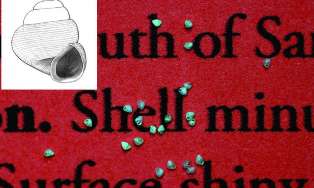
WASHINGTON: Researchers have reported in journal ZooKeys about the smallest snail measuring only 0.02 inches (or 0.5 to 0.6 mm) in northeastern Borneo. The researchers have named the snail as Acmella nana (nanus is the Latin word for dwarf). The research team also listed many other snail species which are quite small in size and have been discovered in Borneo, the Southeast Asian island shared by Brunei, Malaysia and Indonesia.
Few weeks back, researchers working on a project in China had claimed to have found the smallest snail measuring 0.88 mm. The record was earlier held by Chinese Angustopila dominikae snails. Lead author Menno Schilthuizen, a researcher at the Naturalis Biodiversity Center and Leiden University in the Netherlands informed that the research team is not sure about the function of the strange shell which the acmella nana species adorns.


Schilthuizen added, “It’s quite unusual for a land snail, and its narrow, long shape suggests that it would be fragile.”
The research paper published in the journal ZooKeys mentions 48 new species found at various locations in Borneo. Those species have not been named yet. Out of these 48 species, seven have been noticed only in the 4,095-metre-high Mount Kinabalu.
A UPI report said, “Because tiny snails can cover so little ground, they evolve rather specific adaptations for their small patches of habitat. The phenomenon makes them a unique example of the nuances of biodiversity, but also quite ecologically vulnerable.”
The research paper said that new information tells us more about isolated, or endemic, species such as the new record-holder. Moving so slowly, snails can easily get stuck in very small patches of a habitat. There they can spend long enough to evolve and adapt to the particular limited area, undisturbed by the rest of the world. This makes them excellent examples of how endemic species can arise.
On the other hand, their restricted distribution makes them key targets for biodiversity conservation. “A blazing forest fire at Loloposon Cave could wipe out the entire population of Diplommatina tylocheilos,” says co-author Schilthuizen.