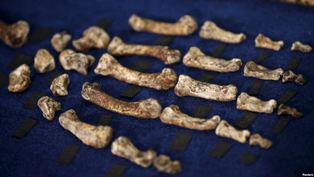


MEXICO: One of the richest collections of early-human fossils ever found has been hauled out of an African cave, thanks to the efforts of a handpicked team of scientists slender enough to fit through ancient narrow passageways, researchers announced.
The fossils, discovered in the dark reaches of the Rising Star cave in South Africa, belong to a new species that arose at the dawn of the family that includes modern humans, the researchers say in a paper in the scientific journal eLife.
The fossils’ age is unknown, but they could be more than 2.5 million years old. Or they could be relatively recent – in the grand scheme of things. Homo sapiens emerged in Africa roughly 200,000 years ago, so the bones are at least that old.
What’s more, the bodies may have been deliberately placed in the cave, suggesting that long-ago human relatives were engaged in ritual disposals of their dead.
“It’s enormously surprising to see a very primitive member of the genus, something with this small a brain,” engaged in an activity that was thought to be unique to modern humans, study co-author Lee Berger of South Africa’s University of the Witwatersrand told reporters Wednesday. “None of us expected it.”
The new species is a strange mishmash of parts. It had hands and feet much like those of other members of the biological group called Homo, which includes our own species, Homo sapiens. Its brain, though, was only about as big as an orange.
The Rising Star ancient humans could manipulate objects with their nimble hands, but their highly curved fingers also made them adept climbers. Their Homo-like feet and long legs show they could walk long distances, but their shoulders are also suited for climbing. The researchers call them Homo naledi, after the word for “star” in the African language Sotho.
The first inkling of the 1,550-plus bits of fossil, representing at least 15 individuals, came from cavers helping Berger prospect for ancient remains. One slot leading to the fossil chamber is just over seven inches wide – less than the width of a sheet of notebook paper.

Karachi Port sets 138-year cargo handling record
KARACHI: Pakistan's maritime sector has achieved a major milestone as Karachi Port set a new record in its 138-year history...