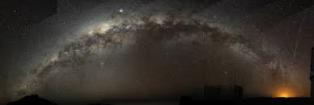


HONG KONG: According to a press release from Penn State University, researchers working with the Sloan Digital Sky Survey-III (SDSS) have mapped out a new representation of the Milky Way that shows how some stars have migrated throughout the galaxy.
The study found that roughly one third of stars have migrated far across the galaxy, which by some estimates reaches 180,000 light years in diameter. The key to telling how far the stars have traveled, and to where, lies in their chemical makeups.
Professor Donald Schneider of Penn State explains that the SDSS incorporated an infrared spectrograph to determine the composition of the stars. This allowed Schneider and his team to trace the locations, motions, and current compositions of roughly 70,000 stars in the Milky Way.
To create the new map, the team monitored 100,000 stars over the course of four years with the spectrograph. The elements present in the atmosphere of each star reveal a unique history that can be traced back to known locations throughout the galaxy where certain elements are commonly found.
By measuring the amount of light that a star gives off at different wavelengths, astronomers can determine the exact components of a star. Chemical enrichment leads to the creation of heavy elements that can signify an older star. In some regions star formation occurs at a rapid pace, and new stars are created much more often than in other regions. Heavy elements are a telltale sign of active star formation, as there are more old stars present in addition to the new ones.
The team also noticed that stars migrate radially, either towards or away from the galaxy’s center. These random migrations in and out of the galaxy occur much more frequently than previously thought, and the study offers new insights into the study of our home in the universe.

Karachi Port sets 138-year cargo handling record
KARACHI: Pakistan's maritime sector has achieved a major milestone as Karachi Port set a new record in its 138-year history...