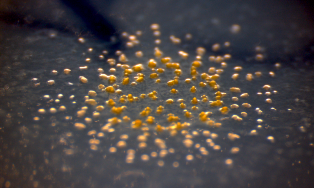
EUROPE: A team of researchers with affiliations to institutions in the U.S., Germany and Switzerland has taken another step towards understanding kin discrimination—at least as it applies to a type of bacteria. In their paper published in Proceedings of the National Academy of Sciences, the group describes experiments they conducted with Myxococcus xanthus, a type of bacteria, and what they found in doing so.
Prior research with M. xanthus, found that if two genetically identical colonies were put on a glass plate a small distance from one another, they would gravitate towards one another and form a large single colony. When two colonies that were not genetically identical were placed on the glass, they did not merge—a clear example of kin discrimination, where an organism favors those that are genetically the same. In this new effort, the researchers took the study a bit further by introducing another factor.


When undergoing periods of a lack of food, M. xanthus create fruiting bodies, which release hardy spores—the spores are able to go without food for a longer period of time, waiting for a better days. The researchers took advantage of this knowledge by placing nutrient lacking bacteria on a plate in the same manner as the prior research team, but this time, rather than watching their behavior, they studied the spores that were created. Close kin created chimera spores (containing cells from members of both colonies) whereas colonies that were not close kin, did not.
Next the researchers sought to learn if kin discrimination came about due to environmental conditions. They cultured 12 different colonies under different conditions to see if it caused discriminatory behavior and then ran the plate experiments again. The colonies showed discrimination against same populations in approximately 2/3 of cases. With those grown under the same conditions, discrimination was observed in approximately half of the cases. Thus, the experiments proved inconclusive. The researchers also looked to see if they could find a genetic basis for kin discrimination by sequencing genomes but could not find a mutation present that might explain it.