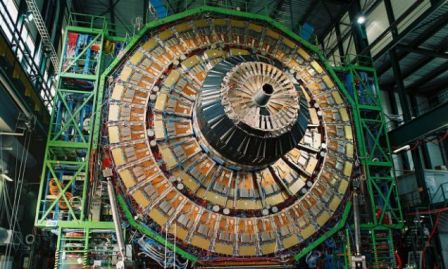


WASHINGTON: The Nobel Prize-winning discovery of the Higgs boson — the “God particle” believed responsible for all the mass in the universe — took place in 2012 at CERN’s Large Hadron Collider, an underground facility where accelerated sub-atomic particles zip around the circumference of a 27-kilometer (16.9-mile) ring-shaped tunnel. But what goes around comes around: more than 50 years ago, the first hint of Higgs was inspired by the study of superconductors — a special class of metals that, when cooled to very low temperatures, allow electrons to move without resistance.
Now, a research team led by Israeli and German physicists has closed a circle, by reporting the first-ever observations of the Higgs mode in superconducting materials.
Unlike the mega-expensive sub-atomic smashups at CERN — a facility that cost about $4.75 billion to build — these findings, presented in the journal Nature Physics, were achieved through experiments conducted in a regular laboratory at relatively low cost.
The discovery of the Higgs boson verified the Standard Model, which predicted that particles gain mass by passing through a field that slows down their movement through the vacuum of space.
“Just as the CERN experiments revealed the existence of the Higgs boson in a high-energy accelerator environment, we have now revealed a Higgs boson analogue in superconductors,” says Professor Aviad Frydman, a member of Bar-Ilan University’s Department of Physics, who directed the study together with Professor Martin Dressel of Stuttgart University, as part of an international collaboration that also included other research teams from Israel, India and the United States. Doctoral student Daniel Sherman, a member of Frydman’s Bar-Ilan laboratory, conducted much of the investigation and is listed as the publication’s first author.

Karachi Port sets 138-year cargo handling record
KARACHI: Pakistan's maritime sector has achieved a major milestone as Karachi Port set a new record in its 138-year history...