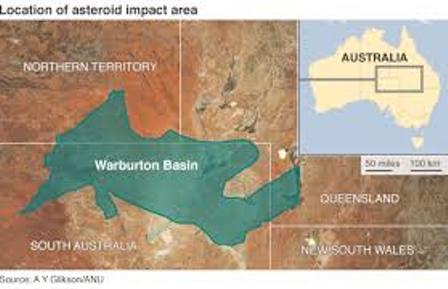


WASHINGTON: Deep in the heart of Australia, intersecting the three territories of Queensland, South Australia, and Northern Territory, is the Warburton Basin. 250 miles wide, the area was hit by an asteroid at least 300 million years ago, research scientists at the Australian National University state. An asteroid broke into two parts before colliding with Earth, each fragment more than six miles across, leaving behind what scientist believe is the largest asteroid impact in the world.
Due to the age of the impact, the craters have been eroded away, leaving little evidence above ground. Geophysical modeling by the research team, however, revealed that under the surface were evidence of two large impacts. Dr Andrew Glikson, leader of the ANU team, used magnetic modeling to explore the extent of the impact area, and discovered that “there are two huge deep domes in the crust, formed by the Earth’s crust rebounding after huge impacts, and bringing up rocks from the mantle below.”
Glikson punctuated the significance of the finding by saying “it would have been curtains for many life species [sic] on the planet at the time.” The team could not locate an extinction event that matched the 300 million year timeframe, however, leading Glikson to believe the impact may be older. Radiometric dating showed that the rocks in the surrounding area of the impact were anywhere from 300 million to 600 million years old.
The impact itself is somewhat of a mystery. The 110 mile wide Chicxulub crater in Mexico, for example, is what eradicated the dinosaurs. That asteroid impact is corroborated by evidence of a mass extinction event in the fossil record, along with sediment from the crater being found all over the world, due to the impact blasting rock and dust around the Earth. The Warburton Basin impact area, however, which is more than twice the size, is not backed up by a mass extinction event or sediment across the globe, leaving the ANU team another discovery to be made.

Karachi Port sets 138-year cargo handling record
KARACHI: Pakistan's maritime sector has achieved a major milestone as Karachi Port set a new record in its 138-year history...