LONDON: At present, lightning rods on tall buildings can increase the likelihood that the high voltage bolts will strike in one place, although the precise path they will take remains unpredictable.
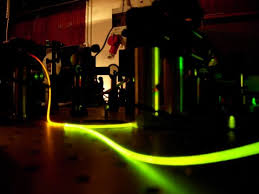
Now Canadian scientists have found a way of directing a lightning arc in the laboratory. They used the Advanced Laser Light Source facility to channel man-made lightning bolts around objects.
The research, by the National Institute of Scientific Research and published in the journal Science Advances, could have implications for industry, where high-voltage arcs are used in a variety of applications.
Yves Bégin, vice dean of research and academic affairs at the INRS, said: ‘Our fascination with lightning and electric arcs aside, this scientific discovery holds out significant potential and opens up new fields of research.’
At present arcs are used in combustion engines, pollution control applications, lighting, machining and micromachining.
The research could ‘multiply’ potential applications for the technology, according to Professor Roberto Morandotti, who led the study at the INRS.
The new technique can bend bolts in ‘S’ shapes and ‘all other kinds in principle’, scientists say
The new technique can bend bolts in ‘S’ shapes and ‘all other kinds in principle’, scientists say


His team guided an electric charge using laser beams to follow a smooth path along straight of parabolic – arched – trajectory.