ISLAMABAD: Health experts, researchers and policymakers have called for stronger tobacco control measures, including regular increases in cigarette taxes, greater public awareness and stricter enforcement, warning that tobacco consumption is claiming thousands of lives annually and imposing a heavy economic and social burden on Pakistan.
Speakers at a discussion, titled: ‘Rethinking Tobacco Control in Pakistan: Advancing Fiscal Policy, Environmental Accountability and Regulation of Emerging Nicotine Products’, highlighted the devastating health consequences of smoking, the growing vulnerability of young people to nicotine addiction and the need for a balanced taxation policy to discourage consumption while curbing tax evasion.


Dr Mohammad Iqbal Khan, Vice-Chancellor of Shifa Tameer-e-Millat University, Islamabad, warned that smoking causes extensive damage to the human body, affecting multiple organs and systems. He said research conducted in Sweden and Melbourne, Australia, in 2017 had identified 39 organs and body systems directly affected by harmful substances in cigarettes, including nicotine and smoke particles. He added that subsequent research in Japan had identified 48 additional forms of damage.
Prof Dr Mohammad Nasir from Institute of Business Administration (IBA) stressed the need to increase tobacco taxation and link it to inflation and income growth to discourage smoking and reduce the affordability of cigarettes.
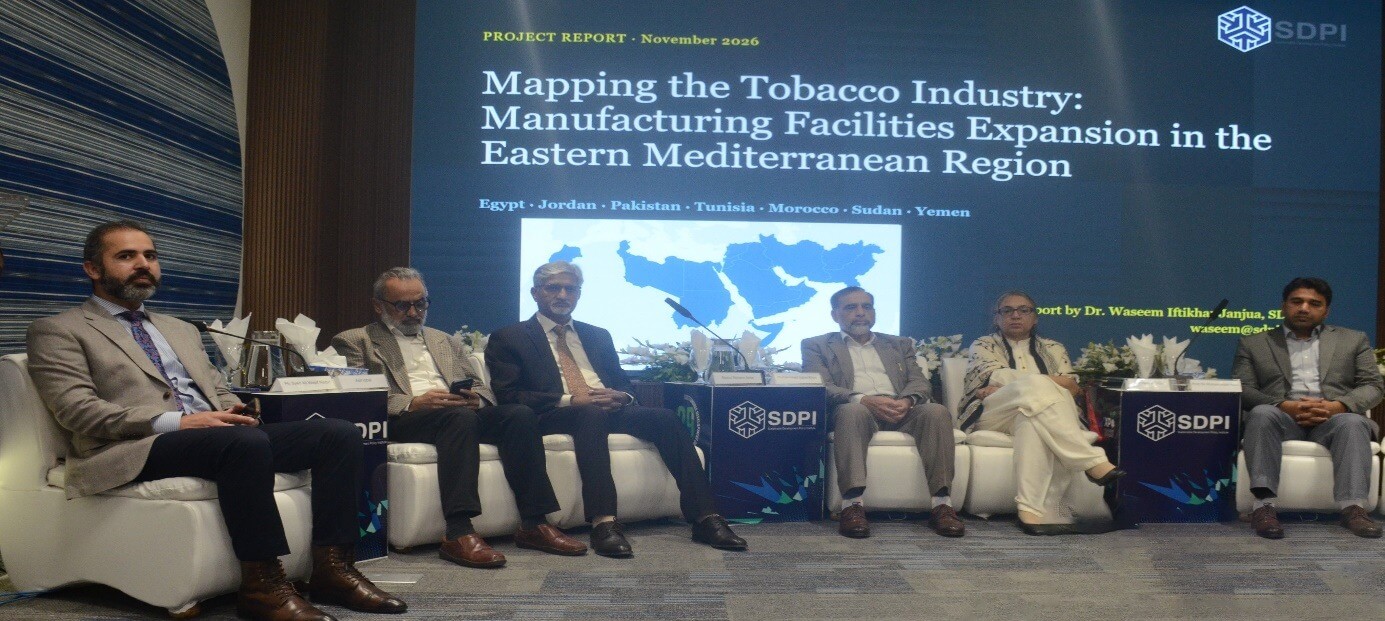
Presenting the findings of a study conducted by the SDPI on the expansion of tobacco industry manufacturing facilities in the Eastern Mediterranean region.
He said the region comprised 22 countries, but the study focused on a purposively selected sample of seven countries. Before the research, evidence about the expansion of tobacco manufacturing facilities across the region was fragmented, with no single source providing a comprehensive picture of the industry’s growth.
Dr Yasmin Albanna of King’s College London, UK, highlighted the need for comprehensive research into the expansion of tobacco industry manufacturing facilities across the Eastern Mediterranean region.
She said the study, conducted by the SDPI, aimed to map tobacco manufacturing facilities and present initial findings on the industry’s expansion in the region.
Dr Asif Iqbal of the Social Policy and Development Centre (SPDC) warned that a freeze on tobacco taxation could encourage more than 300,000 people to start smoking, while costing the government substantial revenue and increasing the public health burden.
He said the latest comparable international data for 2023 showed Pakistan’s smoking-attributable death rate at 79.6 per 100,000 adults, higher than the corresponding rate of around 67 in the Anglo region. He said smoking-related diseases caused approximately 193,000 deaths annually in Pakistan.
Referring to another study conducted in 2019, he said the economic cost of tobacco consumption had been estimated at 1.6 per cent of the country’s GDP, highlighting the enormous financial burden on the economy.
Dr Nadia Tahir of the Prime Minister’s Office called for a balanced and innovative tobacco taxation policy, saying higher tax rates alone may not be sufficient to discourage cigarette consumption and could lead to tax evasion and increased regulatory costs.
She acknowledged the research and data shared by the Sustainable Development Policy Institute (SDPI), saying she was using the figures presented by its researchers to assess the impact of tobacco taxation.
She said the share of cigarettes in federal excise duty (FED) revenue had declined from 40.7 per cent to 29.4 per cent, raising questions about the effectiveness of relying solely on higher tax rates as a revenue-generation measure.
She also warned that higher tax rates could encourage tax evasion, requiring stronger government interventions, including track-and-trace systems, customs monitoring and additional regulatory measures.
She called for a more comprehensive fiscal policy that considered food security, environmental protection, public health and the economic consequences of tobacco consumption rather than relying exclusively on higher cigarette taxes.
Dr Abdur Rehman Abid, an anaesthesiologist, warned that tobacco consumption is causing a serious public health crisis in Pakistan with an estimated 200,000 deaths annually, including 164,000 directly and 31,000 indirectly attributed to smoking.
He said smoking not only damaged individual health but also placed a heavy financial and emotional burden on families and society.
Drawing on his professional experience, he said doctors regularly encountered patients suffering from the consequences of smoking. He recalled the case of a close friend, who despite being seriously ill and shifted to an intensive care unit, asked for a cigarette as his last request.
Dr Abid said tobacco contained nicotine, an addictive substance also found in varying quantities in some other plants. He explained that an ordinary cigarette contained approximately two milligrams of nicotine.
Highlighting the health consequences, he said smoking contributed to heart and vascular diseases, gangrene and amputations, leaving many patients permanently disabled. He also pointed to its possible effects on fertility in both men and women and its role in behavioural problems associated with nicotine addiction.
Referring to Pakistan’s tobacco control commitments, he said bi taxation should be strengthened, arguing that cigarette taxes had remained unchanged since 2023