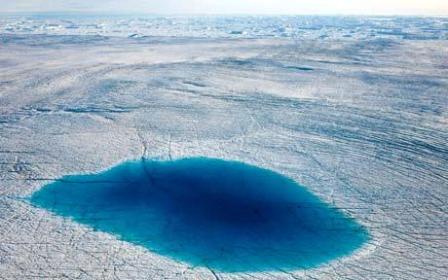
PHOENIX: According to a new study rising temperatures are causing Greenland’s meltwater lakes to drain at a dramatic rate, disappearing in a matter of just a few weeks. A team of British geologists has developed a new way to learn something about the early days of our solar system.
One of the sub-glacial lakes once held about 6.7 billion gallons of water, only to be completely emptied in a single season. The other lake has filled and emptied twice in the last two years – “catastrophic” events that are the result of climate change.


“The fact that our lake appears to have been stable for at least several decades, and then drained in a matter of weeks – or less – after a few very hot summers, may signal a fundamental change happening in the ice sheet,” Ian Howat, an associate professor of earth sciences at The Ohio State University, who led the study, said in a statement.
High temperatures are causing the Greenland Ice Sheet – the second largest ice sheet in the world – to melt. This meltwater then pools beneath the ice; however, it now seems that this process is overwhelming the ice sheet’s natural plumbing system, causing these lakes to simply drain and disappear.
Every time the two-mile-wide lake, described in the journal Nature, fills up, the meltwater carries stored heat – called latent heat – along with it, reducing the stiffness of the surrounding ice and making it more likely to flow out to sea, researchers say.
“If enough water is pouring down into the Greenland Ice Sheet for us to see the same sub-glacial lake empty and re-fill itself over and over, then there must be so much latent heat being released under the ice that we’d have to expect it to change the large-scale behavior of the ice sheet,” co-author Michael Bevis explained.