Customs Today
  • Home
  • Islamabad
  • Karachi
  • Lahore
  • National
  • Transfers and Postings
  • Chambers & Associations
  • Business
No Result
View All Result
Customs Today
  • Home
  • Islamabad
  • Karachi
  • Lahore
  • National
  • Transfers and Postings
  • Chambers & Associations
  • Business
No Result
View All Result
Customs Today
No Result
View All Result
Home Science & Technology Science

Rosetta’s 1st peek at comet’s South Pole

byCustoms Today Report
03/10/2015
in Science, Science & Technology
Share on FacebookShare on Twitter

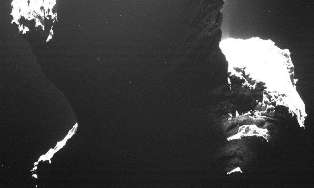
LONDON: Using the Microwave Instrument for the Rosetta Orbiter (MIRO), scientists have studied the comet’s southern polar regions at the end of their long winter season. The data suggest that these dark, cold regions host ice within the first few tens of centimetres below the surface in much larger amounts than elsewhere on the comet.

Since its arrival at Comet 67P/Churyumov-Gerasimenko, Rosetta has been surveying the surface and the environment of this curiously-shaped body. But for a long time, a portion of the nucleus – the dark, cold regions around the comet’s south pole – remained inaccessible to almost all instruments on the spacecraft.


You might also like

Tesla driverless system to use updated radar technology

12/09/2016

Apple to develop its own self-driving technology

10/09/2016

Due to a combination of its double-lobed shape and the inclination of its rotation axis, Rosetta’s comet has a very peculiar seasonal pattern over its 6.5 year-long orbit. Seasons are distributed very unevenly between the two hemispheres, each of which comprises parts of both comet lobes and of the ‘neck’.

For most of the comet’s orbit, the northern hemisphere experiences a very long summer, lasting over 5.5 years, and the southern hemisphere undergoes a long, dark and cold winter. However, a few months before the comet reaches perihelion – the closest point to the Sun along its orbit – the situation changes, and the southern hemisphere transitions to a brief and very hot summer.

When Rosetta arrived at 67P/C-G in August 2014, the comet was still experiencing its long summer in the northern hemisphere and regions on the southern hemisphere received very little sunlight. Moreover, a large part of this hemisphere, close to the comet’s south pole, was in polar night and had been in total darkness for almost five years.


Related Stories

Tesla driverless system to use updated radar technology

byCT Report
12/09/2016

WASHINGTON: Electric carmaker Tesla announced Sunday it was upgrading its Autopilot software to use more advanced radar technology. In a...

Apple to develop its own self-driving technology

byCT Report
10/09/2016

SAN FRANCISCO: Apple may not become an automaker, but it still wants to develop its own self-driving technology. The iPhone-maker's...

NASA spots slowest known magnetar

byCT Report
10/09/2016

WASHINGTON: Astronomers have found evidence of a magnetar - magnetised neutron star - that spins much slower than the slowest...

‘YouTubers’ outshining old-school television

byCT Report
09/08/2016

SAN FRANCISCO: A media revolution is taking place, and most people over 35 years of age aren’t tuned in. Millennial...

Next Post

Fresh perspective on extraordinary cluster of galaxies

  • Terms and Conditions
  • Disclaimer

© 2011 Customs Today -World's first newspaper on customs. Customs Today.

No Result
View All Result
  • Transfers and Postings
  • Latest News
  • Karachi
  • Islamabad
  • Lahore
  • National
  • Chambers & Associations
  • Business
  • About Us

© 2011 Customs Today -World's first newspaper on customs. Customs Today.