You might also like


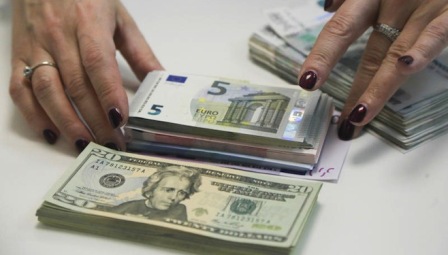
MOSCOW: Russia’s currency, Ruble, weakened 0.3 percent to 52.5840 in Moscow, paring this week’s gain to 9 percent, the most among currencies tracked by Bloomberg globally.
The ruble fell, trimming the biggest weekly advance this year, as the central bank said it will increase the cost of borrowing foreign exchange to stem gains in the world’s best performing currency.
Government bonds known as OFZs rose, pushing five-year yields down 27 basis points to 11.27 percent, the lowest since Dec. 2.
The Bank of Russia will raise the minimum interest rate on foreign-currency repurchase agreements effective April 13, the central bank said on its website. The ruble gained this month as a cease-fire in Ukraine and rebound in oil, Russia’s main export earning, shored up investor confidence.
“This was a very logical move by the central bank,” Alexei Egorov, an analyst at Promsvyazbank in Moscow, said by phone. “The demand for the foreign currency at repo auctions was very strong as investors were using it to carry trade. The fact that the foreign-currency liquidity will be squeezed has impacted the ruble but I don’t see this as a start of a correction.”
The central bank will increase the minimum interest rate on foreign-currency repurchase agreements by half a point to 1.5 percentage point over the London interbank offered rate for 28-day auctions and to Libor plus 1.75 percentage point for one-year offerings, it said in a website statement.
The central bank can also discourage the carry trade by lowering interest rates. Forward-rate agreements show traders are betting on a 1.70 percentage-point reduction in benchmark borrowing costs in the next three months, 20 basis points more than at the start of April. The central bank has lowered its key rate twice this year to 14 percent.
The ruble’s rally sent the currency’s relative-strength index to 82 on Friday, above the threshold of 70 that signals to some analysts that an asset has overshot. Russian households have sold three times the amount of foreign exchange this month as they did in all of March as confidence returned, in according to Sberbank CIB’s estimates.
Gains are also hurting Russia’s budget by reducing the local-currency value of dollar-denominated energy export revenue. Converted into rubles, the price of Brent is at 2,865, the lowest level since January 2011.
This poses a risk for the country in a year when analysts are projecting a fiscal shortfall of 2.3 percent of gross domestic product, the biggest since 2010.