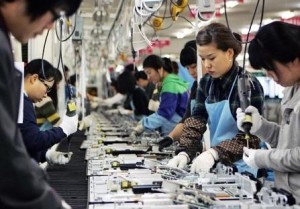
SEOUL: The manufacturing sector saw sales fall last year, the Bank of Korea’s annual corporate analysis report showed Tuesday. According to the central bank report, 12,297 manufacturing firms nationwide saw their sales shrink by 1.6 per cent from the previous year. Their sales grew 0.5 per cent in 2013.
This is the first time that the manufacturing industry has posted negative on-year growth since 1961, when South Korea started to compile official statistics on their performance.


By segment, machinery, electro-mechanics and electronics saw sales slide 5.5 per cent. Nonmetallic minerals producers posted a 3.1 per cent drop, followed by petrochemicals and chemicals with 1.6 per cent, metallic products with 1.2 per cent and shipbuilding with 0.4 per cent.
Manufacturers also suffered a slowdown in profitability, the report noted. The ratio of their operating profit to sales posted 4.2 per cent in 2014, while it was to 5.3 per cent in 2013 and 5.1 per cent in 2012.
Further, the shipbuilding sector saw its profitability index fall by 3.2 per cent last year, marking the only industry showing a negative growth in the profit-to-sales ratio.
A BOK official attributed their performance to “the US dollar’s weakness against the Korean won and the drop in raw materials prices last year.” The strong local currency could be linked to the extreme slump in exports.
Amid the worsening corporate profitability, Financial Supervisory Service Gov. Zhin Woong-seob called for commercial banks to take the initiative in corporate restructuring. In his meeting with chief executives of 10 banks on Tuesday, Zhin said that “It is necessary to distinguish between good and bad (unviable players).”
Via such activities, the market should stop funding to companies that have little potential for business normalisation, he said. His remarks came after a series of research reports showed that the number of “zombie companies” which are unable to generate revenue to pay tax and interest on debts has shot up over the past few years.
According to another BOK data, the number of manufacturing and nonmanufacturing firms with the ratio of operating profit to interest costs below 1 increased to 3,295 as of the end of 2014, up from 2,698 in 2009.
The percentage of such troubled companies rose to 15.2 per cent last year from 12.8 per cent five years earlier, according to the bank. The interest coverage ratio is a barometer of how easily a company can pay interest on outstanding debt. A reading of less than 1 means a company cannot fully pay the interest with its operating profit.