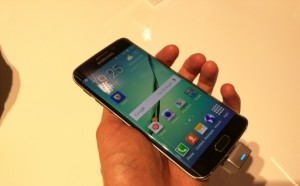
BARCELONA: Samsung has revealed the Galaxy S6 Edge at Mobile World Congress. The new smartphone will be available in April 2015. Samsung offered 32GB, 64GB and 128GB of internal storage with a 5.1 Quad HD display. The price of Galaxy Note Edge has yet not been publicized but its price is rumored to be over £700.
Design and build
You might also like


Visually the Galaxy Note Edge shares the same design philosophy as its sibling, the Galaxy S6, and features a metallic chassis and Gorilla Glass back. This combination of factors made the Galaxy S6 Edge feel like a hybrid of the Sony Xperia Z3 and iPhone 6 during our hands-on at MWC.
The only noticeable difference between the Galaxy S6 Edge and Galaxy S6 is that it’s slightly fatter at 7mm, and has twin Super Amoled Edge Screens, like those on the Galaxy Note Edge, wrapped around its left and right sides.The Edge Screen returns on the Galaxy S6 Edge
We were impressed with the design and found it noticeably more solid and premium than past Galaxy handsets. This is due to the cold forged steel used in the chassis, which Samsung claims is “50 percent stronger than the aluminium used in competing handsets”.
We were also pleased to see the return of the custom fingerprint scanner debuted on the Galaxy S5. Housed in the Galaxy S6 Edge’s physical home button, the scanner offers similar functionality to the TouchID sensor on Apple iPhones.
It means that the Galaxy S6 Edge can be set to unlock or approve certain actions, like in-app purchases or mobile payments, only after the user has proved their identity.
Display
The Galaxy S6 Edge features the same 5.1in Quad HD 2560×1440 577ppi main display as its Galaxy S6 sibling. As with most Samsung Super Amoled displays, we were impressed with the Galaxy S6 Edge screen.
It’s super vibrant, colour balance levels are great, viewing angles are wide and text and icons are crisp.
Operating system
The Galaxy S6 Edge comes with Google’s Android Lollipop operating system, overlaid with the latest version of Samsung Touchwiz.
We’ve found Touchwiz to be a negative in the past, as it floods Samsung handsets with bloatware applications and makes needless changes to the user interface.
Testing the Galaxy S6 Edge, however, we were impressed at how good a job Samsung has done in cleaning up Touchwiz and most of the additions we noticed were positive.The Galaxy S6 Edge has a lighter version of Touchwiz
Key positive additions included the latest version of Knox and Samsung Pay. Knox is a security service compatible with most enterprise mobility management services that lets users create a sandboxed, managed area on the Galaxy S6 Edge.
Samsung Pay is similar to other payment services, but is based on NFC and MST.
The MST tech offers mobile payments “even when a merchant only accepts magnetic stripe wipes”. Samsung has already inked deals with payments services including MasterCard to support Samsung Pay.
The one problem we noticed is that Samsung hasn’t done the same good work it did optimising Touchwiz to work with the Edge displays that it did on the Galaxy Note Edge.
Samsung set up a custom application shortcut menu and push notification menu for the Edge display on the Galaxy Note Edge. We didn’t see either of these services on the Galaxy S6 Edge.
Performance
The Galaxy Note Edge is powered by the same “one of a kind” 14nm, 64bit octa-core processor that combines quad-core 2.1GHz and 1.5GHz parts demonstrated on the Galaxy S6 and boasts 3GB RAM.
We didn’t get a chance to properly benchmark or see how the Galaxy S6 Edge dealt with demanding tasks like 3D gaming during our hands-on. However, in our initial tests we found the handset fairly fast, and it opened applications and web pages very quickly.
Camera
Camera technology is an increasingly competitive area with smartphones. Samsung has loaded the Galaxy S6 Edge with a 16MP rear, F-1.9 with Real Time HDR and Optical Image Stabilisation camera and custom application.
Samsung claims that the F-1.9 lens lets in 60 percent more light than the Galaxy S5’s lens and will radically improve low-light performance.
The Real Time HDR shoots several images and combines them to create a more consistent and accurate photo.