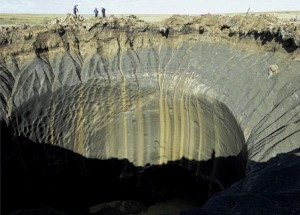


PARIS: Satellite images of the Yamal peninsula in Siberia show that a recently discovered crater in the region is not alone, but surrounded by 20 recently-formed mini-craters.
Appearing 30km from Gazprom’s Bovanenkovo gas field, the craters are being linked to gas emissions from beneath as also a possible massive explosion.
The images show two potentially dangerous objects, where the gas emission can occur at any moment.Until now, only three large craters were known about in northern Russia. None of these were seen in earlier satellite images, showing they are a recent occurrence.
Two of the newly-discovered large craters, or funnels, have turned into lakes, said Professor Vasily Bogoyavlensky, deputy director of the Moscow-based Oil and Gas Research Institute, part of the Russian Academy of Sciences.
“One of the most interesting objects here is the crater that we mark as B2, located 10 kilometres to the south of Bovanenkovo. On the satellite image you can see that it is one big lake surrounded by more than 20 small craters filled with water,” he told The Siberian Times.
Seven craters have been found in the Arctic area, of which five are directly on the Yamal peninsula, one in Yamal Autonomous district, and another on the north of the Krasnoyarsk region, near the Taimyr peninsula.
Many small craters filled with water and merged into one big lake, 50 to 100m in diameter.
“This big lake is surrounded by the network of more than 20 ‘baby’ craters now filled with water and I suppose that new ones could appear last summer or even now. We now counting them and making a catalogue. Some of them are very small, no more than 2 metres in diameter.”
The object B2 is now attracting special attention from the researchers who hope to examine it, despite the dangers in close approach.

Karachi Port sets 138-year cargo handling record
KARACHI: Pakistan's maritime sector has achieved a major milestone as Karachi Port set a new record in its 138-year history...