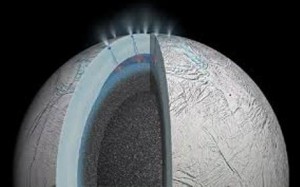


NEW YORK: NASA scientists associated with the Cassini mission have reported possible hydrothermal activity in one of Saturn’s moon, Enceladus. The Cassini spacecraft has revealed this information after years of analysis. The scientists believe that there are several warm oceans beneath the surface of Enceladus which also indicates that the moon could support life. The recent findings have been detailed in the journal Nature.
Cassini spacecraft of NASA has been studying Saturn and its surroundings since the year 2004. According to its observations, one of its moons may have some sort of hydrothermal activity beneath the icy surface. The conclusion was reached by the scientists after analyzing rocky particles which have formed recently due to chemical reactions between rocks and hot water.
Sean Hsu, a researcher at the University of Colorado Laboratory for Atmospheric and Space Physics, and lead author of the study elaborated that such chemical reactions occur only in the presence of water with a temperature of 190 degrees Fahrenheit or more. Hsu and his colleagues wrote “We report an analysis of silicon-rich, nanometre-sized dust particles (so-called stream particles) that stand out from the water-ice-dominated objects characteristic of Saturn.”
The researchers suggest that these particles, initially embedded in the icy grains, were emitted from Enceladus’ subsurface waters and released by sputter erosion in Saturn’s E ring. Hydrothermal activity occurs when sea water reacts with rocky crust and consequently a warm and mineral-laden solution emerges. Such activities occur naturally in the oceans of Earth and the new study indicates that Saturn’s moon Enceladus may also have similar active processes.

Karachi Port sets 138-year cargo handling record
KARACHI: Pakistan's maritime sector has achieved a major milestone as Karachi Port set a new record in its 138-year history...