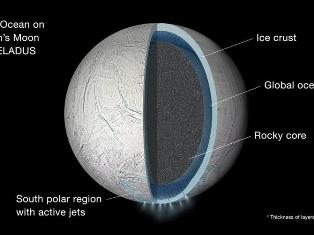


HONG KONG: A global ocean lies beneath the icy crust of Saturn’s geologically active moon Enceladus, researchers have revealed.They say the find explains the moon’s wobble, and mysterious icy sprays seen at its south pole.The findings show the fine spray of water vapour, icy particles and simple organic molecules Cassini has observed coming from fractures near the moon’s south pole is being fed by this vast liquid water reservoir.
Using data from NASA’s Cassini mission, researchers found the magnitude of the moon’s very slight wobble, as it orbits Saturn, can only be accounted for if its outer ice shell is not frozen solid to its interior, meaning a global ocean must be present.
The research is presented in a paper published online this week in the journal Icarus.Previous analysis of Cassini data suggested the presence of a lens-shaped body of water, or sea, underlying the moon’s south polar region.
However, gravity data collected during the spacecraft’s several close passes over the south polar region lent support to the possibility the sea might be global, the team say.
The new results confirmed this.‘This was a hard problem that required years of observations, and calculations involving a diverse collection of disciplines, but we are confident we finally got it right,’ said Peter Thomas, a Cassini imaging team member at Cornell University, Ithaca, New York, and lead author of the paper.
Cassini scientists analyzed more than seven years’ worth of images of Enceladus taken by the spacecraft, which has been orbiting Saturn since mid-2004. They carefully mapped the positions of features on Enceladus – mostly craters – across hundreds of images, in order to measure changes in the moon’s rotation with extreme precision. As a result, they found Enceladus has a tiny, but measurable wobble as it orbits Saturn.
Because the icy moon is not perfectly spherical – and because it goes slightly faster and slower during different portions of its orbit around Saturn – the giant planet subtly rocks Enceladus back and forth as it rotates.
The team plugged their measurement of the wobble, called a libration, into different models for how Enceladus might be arranged on the inside, including ones in which the moon was frozen from surface to core.

Karachi Port sets 138-year cargo handling record
KARACHI: Pakistan's maritime sector has achieved a major milestone as Karachi Port set a new record in its 138-year history...