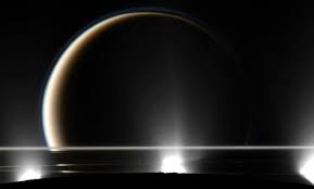
CANADA: Scientists will soon be able say if one of Saturn’s moons is conducive to life as we know it.
Are we alone? Tantalising clues may come sooner than expected – and not from a planet but a remote icy moon known as Enceladus, which is circling the ringed planet, Saturn.


Moons are now considered more likely than planets to harbour alien life forms. And of all the solar system’s many moons, none are likelier candidates than Enceladus, according to NASA scientists who have analysed samples taken during the Cassini spacecraft’s closest-ever flyby of themoon.
The samples are believed to provide compelling evidence that life could exist in liquid water beneath the frozen surface of geologically active Enceladus.
The Cassini probe collected samples from plumes of gas and dust-sized icy particles as it passed within a record 49 kilometres of the surface of the moon’s South Pole.
“It’s the best sample ever from an ocean beyond Earth and I’m looking forward to the final results from the spacecraft’s on-board dust analyser,” said NASA scientist Candy Hansen.
“We will be able to say if the environment is conducive to life – whether it is habitable for life as we know it.”
Scientists say a huge ocean lurks beneath the moon’s surface and conditions might be favourable for microbial organisms to exist.