
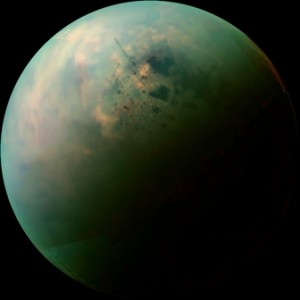


WASHINGTON: Scientists say that Saturn’s moon Titan may indeed be harboring life – but the type of life forms that may be gathered beneath its mysterious surface might be more alien that we might think.
Titan is understood to have vast seas and rivers of liquid methane instead of liquid water, as the temperature on the satellite is much too low to harbor anything but water in solid form. However, with its nitrogen-rich atmosphere, the cycle of methane falling in rain and then evaporating to form clouds is thought to mimic the Earth’s water cycle; this has prompted scientists to theorize that methane-based organic matter could exist on the moon that can exist without the presence of oxygen.
The research team responsible for the work, led by graduate student James Stevenson and molecular dynamics specialist Paulette Clancy, says that a cell membrane capable of functioning in the incredibly cold 292 methane waters of Titan at degrees below zero, could be composed of small-sized organic nitrogen compounds. Jonathan Lunine, Cornell’s director for the Center of Radiophysics and Space Research, co-authored the study.
An expert on Saturn’s moons, Lunine was a member of the Cassini-Huygens probe team that was behind the discoveries of liquid methane and ethane on Titan. Mesmerized by the possibilities of methane-based life on the moon, Lunine recruited Clancy, Stevenson and others to delve into the matter. While the team had neither astronomers nor biologists onboard, Clancy says the tools they did bring were suitable to the investigation. In addition, the lack of preconceptions about what can exist within a membrane and what can’t helped the team work the compounds that they knew were available on Titan, according to the molecular dynamics specialist.

Karachi Port sets 138-year cargo handling record
KARACHI: Pakistan's maritime sector has achieved a major milestone as Karachi Port set a new record in its 138-year history...


