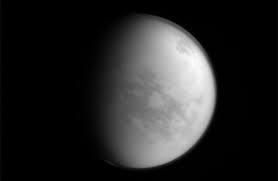


WASHINGTON: Saturn’s moon Titan’s atmosphere could bear more similarity to the Earth’s atmosphere than previously thought, researchers from the University College London (UCL) say.
The UCL team analysed data gathered over seven years by the international Cassini probe and found that the interactions between Titan’s atmosphere and the solar magnetic field and radiation create a wind of hydrocarbons and nitriles being blown away from its polar regions into space.
This is very similar to the wind observed coming from the Earth’s polar regions.
Like the Earth and Venus, and unlike any other moon, Titan has a rocky surface and a thick atmosphere. It is the only object in the solar system apart from the Earth to have rivers, rainfall and seas, and it is bigger than the planet Mercury.
“Titan’s atmosphere is made up mainly of nitrogen and methane, with 50 percent higher pressure at its surface than on Earth,” said study leader Andrew Coates.
“Data from Cassini Plasma Spectrometer (CAPS) proved a few years ago that the top of Titan’s atmosphere is losing about seven tonnes of hydrocarbons and nitriles every day, but did not explain why this was happening. Our study provides evidence for why this is happening,” Coates said.
Nitriles are molecules with nitrogen and carbon tightly bound together.
The research, published in the journal Geophysical Research Letters, explains that this atmospheric loss is driven by a polar wind powered by an interaction between sunlight, the solar magnetic field and the molecules present in the upper atmosphere.

Karachi Port sets 138-year cargo handling record
KARACHI: Pakistan's maritime sector has achieved a major milestone as Karachi Port set a new record in its 138-year history...