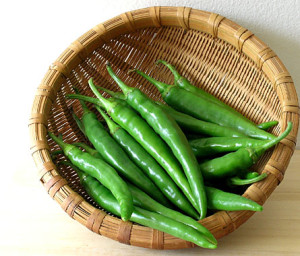
RIYADH: In a significant development, Saudi Arabia has lifted a seven-month old ban on import of green chilly from India. The phytosanitary authority of Saudi Arabia had imposed a temporary ban on import of the commodity in May 2015 over sub-standard quality of goods shipped by Indian exporters. The authority had set a quality specification of European standard for allowing import of green chilly from India.
Opening up of Saudi Arabian market is important for Indian green chilly exporters due to the lack of alternative markets for substitution. Owing to less demand of Indian chilly in developed countries, including the Unites States and the European Union, Indian exporters depend largely upon the Middle East countries for its demand. Though, very small in volume, green chilly forms an important segment in the entire basket of vegetables’ exports.

“Saudi Arabian authorities have lifted temporary ban imposed on import of green chilly from India. Exporters are hereby advised to follow the strict guidelines set by Saudi Arabia to start exports of green chilly,” said a statement from the Agricultural and Processed Food Products Export Development Authority (Apeda).
Data collated by Apeda showed a 31% decline in exports of green chilly from India in the financial year 2014-15 at 32,138.19 tonnes as compared to 46,540.15 tonnes in the previous year. Despite such a steep decline in volume terms, green chilly shipment exports in value term recorded a marginal decline at $22.23 million in 2014-15 as against $22.96 million in the previous year. In 2012-13, however, India’s green chilly exports were recorded at 35,991.97 tonnes worth $16.82 million.
With 1,266.69 tonnes worth $0.85 million, Saudi Arabia slipped to the fourth position in terms of green chilly exports from India in 2014-15 only after United Arab Emirates (19561.56 tonnes worth $13.73 million), United Kingdom (2244.02 tonnes valued $2.63 million) and Qatar (2344.89 tonnes worth $1.57 million).
In the previous year i.e. 2013-14, however, Saudi Arabia was the third-largest destination of Indian green chilly with 3,045.87 tonnes worth $2.33 million.
“Opening up of Saudi Arabian market is the result of our extreme efforts and continuous dialogues with the authority there. We assured them that Indian exporters would adhere to the quality specification set by the Saudi Arabian phytosanitary authority,” said R Ravindra, deputy general manager (in charge of green chilly), Apeda.
Apeda has advised interested Indian exporters to take utmost care with respect to quality and adhere to Saudi Arabian import norms. The procedure for export of vegetables is an attempt to facilitate adhering to the quality requirements.
“More than opening up of its market, there used to be a fear that other importing countries might raise questions on the quality following ban imposed by Saudi Arabia. Since the ban is lifted, the fear evaded,” said Ravindra. Apeda, meanwhile, has advised exporters to strengthen backward linkages to have full control, monitoring and supervision of specified quality.