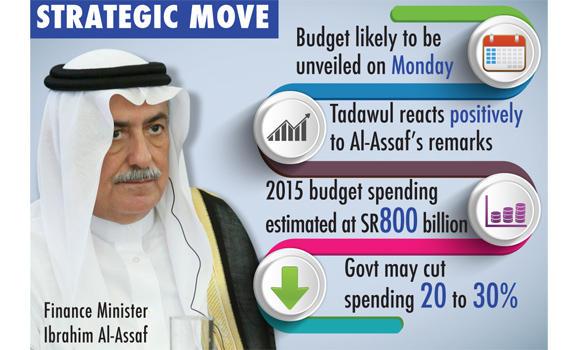
RIYADH: The low cut of oil prices effects Saudi Arabia economy but we will continue massive public spending, said Finance Minister Ibrahim Al-Assaf here the other day.
The minister said the 2015 budget is ready and would be unveiled in the near future. Financial analysts expect that Custodian of the Two Holy Mosques King Abdullah would approve the budget on Monday.
Al-Assaf said the budget comes during “challenging” global economic conditions but surpluses and reserves built over many years by the Kingdom have given it “depth and a line of defense that come in handy in times of need.”
He said this policy would continue, enabling the government to implement massive projects in health, education, social services and development as well as state security. “This spending, combined with private sector activity, is expected to bring positive economic growth,” he added.
The Saudi stock market reacted positively to Al-Assaf’s remarks. The Tadawul All-Share Index jumped 4.21 percent to 7,638.9 points on Wednesday after plunging 7.27 percent on Tuesday. Over SR8.57 billion worth of shares traded on Wednesday.
Basil Al-Ghalayini, CEO of BMG Financial Group, said Al-Assaf’s positive and bold message was instrumental in calming traders’ nervousness. “It is interesting to witness the timing of this budget to coincide with the first major reshuffle of the Saudi Cabinet in years. It is widely anticipated by Wthe business community to have these fresh and young talents of the newly appointed ministers to add noticeable values in managing this counter-cyclical budget,” Al-Ghalayini said.
Another prominent economist, who requested anonymity, said he also expected the government to continue massive spending on development and welfare projects to spur growth. “While I would expect spending to continue to increase, the rate of increase may be moderate,” he said.
He added: “The oil price assumption will be important but one way for the government to demonstrate its resolve might be to unveil a deficit budget. They can certainly afford it. I suspect there will continue to be a strong emphasis on social infrastructure spending, such as education and healthcare. Potentially they may announce some new major projects to highlight continuity.”
Crude prices have fallen to multi-year lows since June in the face of a global supply glut and slower growth in demand.
Prices have plunged even further since last month, when the Organization of the Petroleum Exporting Countries decided against cutting production.
US benchmark West Texas Intermediate crude for January delivery sank a further $1.16 in afternoon Asian trade, to $54.77 on Wednesday. Brent crude for February shed 71 cents to $59.30.
In its 2014 budget, the government projected a balanced budget of SR855 billion ($228 billion). This was the sixth budget since the global financial crisis. It continues the expansionary path the Kingdom has taken since then, with substantial additional outlays for education, health and infrastructure, despite the decline in oil revenue.
Government expenditure rose in 2013 to SR927 billion ($247 billion), an increase of 15 percent over 2012. Spending went over budgeted outlays by about 13 percent. Remarkably, despite lavish government expenditure, inflation was kept at around 3 percent. Actual revenue in 2013 exceeded budgeted revenue by a massive 34 percent.
According to experts, the forthcoming budget would be around SR800 billion if the price of oil ranges between $50 to $60 per barrel. The Kingdom would possibly adopt an austerity budget or resort to its huge cash reserves, they said.
Ihsan Buhulaiga, an economist, said government might cut spending by 20 to 30 percent, or SR200 billion, compared to the 2014 budget. This would not affect mega projects, part of which have already been delayed or stalled.
However, if the price of oil falls below $60 per barrel, the Kingdom may resort to reserves to allocate SR855 billion as an estimated spending target for 2015, he said.