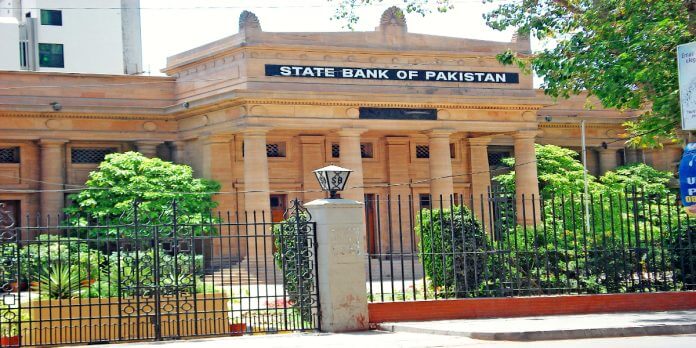
KARACHI: State Bank of Pakistan announced its new Monetary Policy Statement, maintaining the existing policy rate of 9.75 percent.
SBP’s Monetary Policy Committee, in its meeting here, decided to go with the same policy rate (interest) for next two months, unless any development calls for early revision.

The decision reflected the MPC’s view that the outlook for inflation has improved following the cuts in fuel prices and electricity tariffs announced last week as part of the government’s relief package, said SBP statement.
It said that at the same time, high-frequency indicators suggest that growth continued to moderate to a more sustainable pace. This moderation should help keep at bay demand-side pressures on inflation and contain non-oil imports, notwithstanding the significant uncertainty about the future path of global energy and food prices due to the Russia-Ukraine conflict.
Since the last MPC meeting on January 24, 2022, headline inflation moderated in February to 12.2 percent year-on-year. Inflation in February would have been noticeably lower.
Core inflation also fell in urban areas and inflation expectations have remained stable, suggesting that second-round effects from higher commodity prices remain contained.
On the external front, despite the rise in global prices, the February trade deficit witnessed a further 10 percent contraction month-on-month basis on top of the 29 percent decline recorded in January, confirming the slowdown in domestic demand. While the current account deficit rose in January, this largely reflected lumpy imports of oil, vaccines and other items financed through loans and supplier credit.
Excluding these imports, the deficit would have been about $1 billion lower, suggesting that the underlying trend in the current account balance is also moderating.
Looking ahead, the MPC noted that while current real interest rates on a forward-looking basis are appropriate to guide inflation to the medium-term range of 5-7 percent, support growth, and maintain external stability, the Russia-Ukraine conflict has introduced a high degree of uncertainty in the outlook for international commodity prices and global financial conditions.
Continued adverse conditions on these fronts could pose challenges to the outlook for the current account deficit and inflation expectations, which could necessitate changes in the policy rate. Since the Russia-Ukraine situation remains fluid, the MPC noted that it was prepared to meet earlier than the next scheduled MPC meeting in late April, if necessary, to take any needed timely and calibrated action to safeguard external and price stability.
In reaching its decision, the MPC considered key trends and prospects in the real, external and fiscal sectors, and the resulting outlook for monetary conditions and inflation.
Real Sector: Growth continues to moderate on the back of high prices and demand-easing measures. Since the last meeting, automobile sales and electricity generation have declined month-on-month. Sales of petroleum products and cement have also decelerated since last October.
In the second quarter of the current fiscal year, growth in fast-moving consumer good (FMCG) sales dipped and general sales tax collections from services were lower than last year. On the supply side, LSM growth has been revised upward following the rebasing, settling at around 5-6 percent year-on-year since October.
Agricultural prospects have somewhat weakened, with key inputs such as fertilizer off-take and water availability during the Rabi season lower than last year. Cotton and wheat production will likely be less than previous estimates. Growth in FY22 is still expected around the middle of the previously forecast range of 4-5 percent.