Customs Today
  • Home
  • Islamabad
  • Karachi
  • Lahore
  • National
  • Transfers and Postings
  • Chambers & Associations
  • Business
No Result
View All Result
Customs Today
  • Home
  • Islamabad
  • Karachi
  • Lahore
  • National
  • Transfers and Postings
  • Chambers & Associations
  • Business
No Result
View All Result
Customs Today
No Result
View All Result
Home Science & Technology Science

Scientists caught glimpse of black hole swallowing a star

bySana Anwar
27/11/2015
in Science, Science & Technology
Share on FacebookShare on Twitter

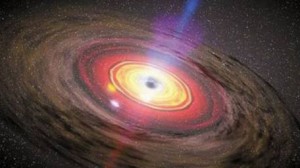
LONDON: Scientists for the first time caught a glimpse of a black hole swallowing a star and shooting out a high-speed flare of matter at the centre of a nearby galaxy.

The finding, reported in the US journal Science, tracked this star — about the size of the Sun — as it shifted from its customary path, slipped into the gravitational pull of a supermassive black hole and was sucked in, Xinhua quoted lead author Sjoert van Velzen of the Johns Hopkins University as saying on Thursday.


You might also like

Tesla driverless system to use updated radar technology

12/09/2016

Apple to develop its own self-driving technology

10/09/2016

Though extremely rare, supermassive black holes were spotted previously eating a star alive. Scientists have also seen flares, or jets, from supermassive black holes.

“But this is the first time we got a clear view of the stellar destruction, followed by the jet,” van Velzen said.

“The jet is also of much lower power than what we have seen before, which is present an interesting puzzle.”

Van Velzen led the analysis and coordinated efforts of 13 other scientists in the US, the Netherlands, Britain and Australia. The team compared the energy produced by the jet in this event to the entire energy output of the Sun over 10 million years.

They concluded that it was likely all supermassive black holes swallowing stars launched jets but this discovery was made possible because the black hole is relatively close to the Earth and was studied soon after it was first seen.

The black hole is only 300 million light-years away from the Earth and the team was able to make their first observations using radio telescopes only three weeks after it was found, they said.

“Our new findings suggest that this type of jet could indeed be common,” he said.

“Finding more of these rare events may further our understanding of the processes that allow black holes to launch such spectacular outflows.”


Related Stories

Tesla driverless system to use updated radar technology

byCT Report
12/09/2016

WASHINGTON: Electric carmaker Tesla announced Sunday it was upgrading its Autopilot software to use more advanced radar technology. In a...

Apple to develop its own self-driving technology

byCT Report
10/09/2016

SAN FRANCISCO: Apple may not become an automaker, but it still wants to develop its own self-driving technology. The iPhone-maker's...

NASA spots slowest known magnetar

byCT Report
10/09/2016

WASHINGTON: Astronomers have found evidence of a magnetar - magnetised neutron star - that spins much slower than the slowest...

‘YouTubers’ outshining old-school television

byCT Report
09/08/2016

SAN FRANCISCO: A media revolution is taking place, and most people over 35 years of age aren’t tuned in. Millennial...

Next Post

PetroChina to sell stake in Trans-Asia gas pipeline for $2.4bn

  • Terms and Conditions
  • Disclaimer

© 2011 Customs Today -World's first newspaper on customs. Customs Today.

No Result
View All Result
  • Transfers and Postings
  • Latest News
  • Karachi
  • Islamabad
  • Lahore
  • National
  • Chambers & Associations
  • Business
  • About Us

© 2011 Customs Today -World's first newspaper on customs. Customs Today.