Customs Today
  • Home
  • Islamabad
  • Karachi
  • Lahore
  • National
  • Transfers and Postings
  • Chambers & Associations
  • Business
No Result
View All Result
Customs Today
  • Home
  • Islamabad
  • Karachi
  • Lahore
  • National
  • Transfers and Postings
  • Chambers & Associations
  • Business
No Result
View All Result
Customs Today
No Result
View All Result
Home Latest News

Scientists create new bio-ink for 3D printing

byCT Report
24/06/2016
in Latest News, Technology
Share on FacebookShare on Twitter

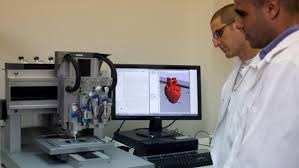
LONDON:  Scientists from University of Bristol have found a new bio-ink for 3D printing with stem cells that allows printing of living tissue known as bio-printing.

The new bio-ink contains two different polymer components: a natural polymer extracted from seaweed and a sacrificial synthetic polymer used in the medical industry.


You might also like

Pakistan faces mango export challenges amid Afghanistan border closure, Gulf tensions

13/05/2026

Qatari LNG tanker heads via Strait of Hormuz to Pakistan, shows data

13/05/2026

“Designing the new bio-ink was extremely challenging. You need a material that is printable, strong enough to maintain its shape when immersed in nutrients and that is not harmful to the cells. We managed to do this,” said lead researcher Adam Perriman from school of cellular and molecular medicine.

The synthetic polymer causes the bio-ink to change from liquid to solid when the temperature is raised and the seaweed polymer provides structural support when the cell nutrients are introduced.

“The special bio-ink formulation was extruded from a retrofitted benchtop 3D printer, as a liquid that transformed to a gel at 37 degrees Celsius, which allowed construction of complex living 3D architectures,” Perriman added.

The findings, published in the journal Advanced Healthcare Materials, could help printing complex tissues using the patient’s own stem cells for surgical bone or cartilage implants, which could be used in knee and hip surgeries.

The team was able to differentiate the stem cells into osteoblasts — a cell that secretes the substance of bone cells that have secreted the matrix of cartilage and become embedded in it — to engineer 3D printed tissue structures over five weeks, including a full-size tracheal cartilage ring.

“What was really astonishing for us was when the cell nutrients were introduced, the synthetic polymer was completely expelled from the 3D structure, leaving only the stem cells and the natural seaweed polymer,” Perriman noted.

This created microscopic pores in the structure which provided more effective nutrient access for the stem cells.


Related Stories

Pakistan faces mango export challenges amid Afghanistan border closure, Gulf tensions

byCT Report
13/05/2026

ISLAMABAD: Pakistan mango export sector is facing mounting challenges due to geopolitical tensions in Afghanistan and the Middle East, threatening...

Qatari LNG tanker heads via Strait of Hormuz to Pakistan, shows data

byCT Report
13/05/2026

KARACHI: A second Qatari liquefied natural gas tanker is transiting the Strait of Hormuz days after the first such cargo...

RCCI inks MoU with China’s IBI Group to promote industrial cooperation

byCT Report
13/05/2026

RAWALPINDI: The Rawalpindi Chamber of Commerce & Industry (RCCI) signed a Memorandum of Understanding (MoU) with China’s IBI Group during...

Pakistan weighs fertiliser imports from Central Asia amid fears of supply disruptions

byCT Report
13/05/2026

ISLAMABAD: Prime Minister Shehbaz Sharif directed the authorities to ensure timely provision of fertiliser to farmers at all costs and...

Next Post

Oman Air wants 36% increase in bilateral flying rights from India

  • Terms and Conditions
  • Disclaimer

© 2011 Customs Today -World's first newspaper on customs. Customs Today.

No Result
View All Result
  • Transfers and Postings
  • Latest News
  • Karachi
  • Islamabad
  • Lahore
  • National
  • Chambers & Associations
  • Business
  • About Us

© 2011 Customs Today -World's first newspaper on customs. Customs Today.