Customs Today
  • Home
  • Islamabad
  • Karachi
  • Lahore
  • National
  • Transfers and Postings
  • Chambers & Associations
  • Business
No Result
View All Result
Customs Today
  • Home
  • Islamabad
  • Karachi
  • Lahore
  • National
  • Transfers and Postings
  • Chambers & Associations
  • Business
No Result
View All Result
Customs Today
No Result
View All Result
Home Science & Technology Science

Scientists detect galaxy’s supermassive black hole

byCT Report
10/12/2015
in Science, Science & Technology
Share on FacebookShare on Twitter

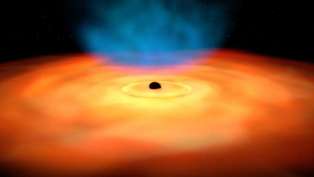
WASHINGTON: The Milky Way, like most galaxies, has a supermassive black hole sitting right in its centre. Now, for the first time, scientists have detected a magnetic field just outside the event horizon – or outer boundary – of that black hole. Why do we care? Because that magnetic field is probably what makes our neighbourhood black hole so powerful.

It shouldn’t come as a surprise to you that black holes “suck” stars in and tear them apart. But the process doesn’t actually work as simply as vacuuming up some dust. Lots of matter is able to orbit the black hole at a safe distance, creating a flat disk full of all sorts of cosmic goodies. But this so-called accretion disk is magnetised, and the hot, turbulent conditions cause all sorts of wonky interactions between the different magnetic fields. These interactions are thought to be critical to the black hole’s ability to acquire matter – and to its ability to turn that matter into intense radiation that jets into space, shaping surrounding galaxies.


You might also like

Tesla driverless system to use updated radar technology

12/09/2016

Apple to develop its own self-driving technology

10/09/2016

“Understanding these magnetic fields is critical. Nobody has been able to resolve magnetic fields near the event horizon until now,” Michael Johnson, of the Harvard-Smithsonian Centre for Astrophysics, the lead author of a paper on the findings published on Thursday in Science, said in a statement.

To find evidence of these magnetic fields around Sagittarius A, the black hole at the centre of our galaxy, scientists needed a telescope as big as Earth itself. Well, not a telescope, exactly: They used the Event Horizon Telescope (EHT), which is a network of radio telescopes across the globe. When you put all those radio telescopes together into one massive array, you can see some really hard to spot stuff – including compact black holes.


Related Stories

Tesla driverless system to use updated radar technology

byCT Report
12/09/2016

WASHINGTON: Electric carmaker Tesla announced Sunday it was upgrading its Autopilot software to use more advanced radar technology. In a...

Apple to develop its own self-driving technology

byCT Report
10/09/2016

SAN FRANCISCO: Apple may not become an automaker, but it still wants to develop its own self-driving technology. The iPhone-maker's...

NASA spots slowest known magnetar

byCT Report
10/09/2016

WASHINGTON: Astronomers have found evidence of a magnetar - magnetised neutron star - that spins much slower than the slowest...

‘YouTubers’ outshining old-school television

byCT Report
09/08/2016

SAN FRANCISCO: A media revolution is taking place, and most people over 35 years of age aren’t tuned in. Millennial...

Next Post

Australian stocks end: S&P 200 down 42.8pts

  • Terms and Conditions
  • Disclaimer

© 2011 Customs Today -World's first newspaper on customs. Customs Today.

No Result
View All Result
  • Transfers and Postings
  • Latest News
  • Karachi
  • Islamabad
  • Lahore
  • National
  • Chambers & Associations
  • Business
  • About Us

© 2011 Customs Today -World's first newspaper on customs. Customs Today.