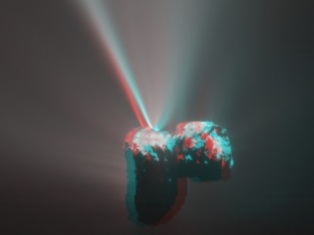
MEXICO: For the first time ever, scientists have detected oxygen on a comet, a discovery that could challenge theories about the solar system’s formation. The oxygen was then not further “processed” in the early solar system.
“All the models say it shouldn’t be there and it shouldn’t survive for such a long time”, said Andre Bieler, who studies cometary science at the University of Michigan. Bieler and his co-author Kathrin Altwegg are now scanning the 1986 records of Halley’s Comet, seeing if molecular oxygen was detected at the time. The spectral lines of oxygen are too faint to be seen from Earth.


The worldwide team of researchers published their findings in Nature Wednesday, stating that an unexpectedly large amount of molecular oxygen was found in the cloud of gas, or coma, surrounding comet 67P/Churyumov-Gerasimenko’s nucleus. Examples of elements detected by Rosetta include carbon dioxide, carbon monoxide, and water.
“Check out a little gallery of Rosetta’s comet below (courtesy of ” title=” target=”_blank” Space.com), and catch up on the Escapist’s coverage of the probe and its Philae lander here. The discovery was made by the ROSINA mass spectrometer, an instrument aboard the Rosetta spacecraft, which has been tailing the comet since August 2014, reports the Los Angeles Times. The scientists spent months making sure that the oxygen was not an instrument glitch.
The oxygen also seemed to “follow” the comet, and remained in constant quantities even as 67P shed its outer layers to the Sunday. The findings lead to two puzzles for computer modelers to tackle. Yet, Rosetta showed that oxygen does exist in the comet’s halo of gases.