Customs Today
  • Home
  • Islamabad
  • Karachi
  • Lahore
  • National
  • Transfers and Postings
  • Chambers & Associations
  • Business
No Result
View All Result
Customs Today
  • Home
  • Islamabad
  • Karachi
  • Lahore
  • National
  • Transfers and Postings
  • Chambers & Associations
  • Business
No Result
View All Result
Customs Today
No Result
View All Result
Home Science & Technology Science

Scientists develop robotic swans that helps to tackle water pollution

byCustoms Today Report
22/08/2015
in Science, Science & Technology
Share on FacebookShare on Twitter

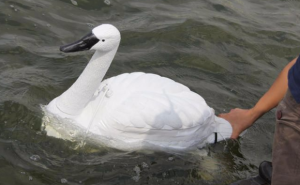
LONDON: Scientists at the National University of Singapore have developed autonomous robotic swans that collect real-time data on the water quality of the city’s lakes and reservoirs.

The swans are part of the New Smart Water Assessment Network project – NuSwan – which aims to find a low-cost, aesthetically unobtrusive way to measure water quality in urban environments.


You might also like

Tesla driverless system to use updated radar technology

12/09/2016

Apple to develop its own self-driving technology

10/09/2016

Sensors on the swan’s body measure acidity, oxygen and chlorophyll levels in the water, and can also collect samples for closer examination in the laboratory.

Currently, testing is carried out manually using a boat – a process which is time-consuming and costly. The scientists say the swans are a cheaper, more efficient way to do the same job.

The floating robots use GPS and mobile data networks to calculate their movements and transmit data back to the researchers in real time. Scientists can also give the swans instructions via text message, for example to visit a certain location on a lake or collect a water sample. The swans, which are powered by electric motors, automatically return to docking stations to recharge.

Following final testing the researchers plan to commercially deploy the swans in lakes and reservoirs across Singapore. There has also been strong interest in the technology from other nations – notably China, where air and water pollution has long been a matter of public concern.

The team is also working with other universities to extend the swans’ capabilities, including the development of a phosphate sensor to monitor for algal blooms, which can be lethal to fish and other marine life.

The swans are the latest example of new smart city technologies that aim to make cities greener and more efficient. In particular, London’s Canary Wharf has become a smart city test bed, with plans for solar-powered smart benches, buildings powered by anaerobic digestion and high-tech logistics systems.


Related Stories

Tesla driverless system to use updated radar technology

byCT Report
12/09/2016

WASHINGTON: Electric carmaker Tesla announced Sunday it was upgrading its Autopilot software to use more advanced radar technology. In a...

Apple to develop its own self-driving technology

byCT Report
10/09/2016

SAN FRANCISCO: Apple may not become an automaker, but it still wants to develop its own self-driving technology. The iPhone-maker's...

NASA spots slowest known magnetar

byCT Report
10/09/2016

WASHINGTON: Astronomers have found evidence of a magnetar - magnetised neutron star - that spins much slower than the slowest...

‘YouTubers’ outshining old-school television

byCT Report
09/08/2016

SAN FRANCISCO: A media revolution is taking place, and most people over 35 years of age aren’t tuned in. Millennial...

Next Post

European stocks: Stoxx Europe 600 falls 1% in early move

  • Terms and Conditions
  • Disclaimer

© 2011 Customs Today -World's first newspaper on customs. Customs Today.

No Result
View All Result
  • Transfers and Postings
  • Latest News
  • Karachi
  • Islamabad
  • Lahore
  • National
  • Chambers & Associations
  • Business
  • About Us

© 2011 Customs Today -World's first newspaper on customs. Customs Today.