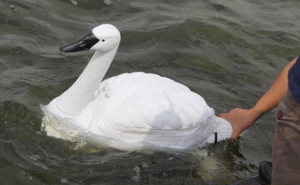
LONDON: Scientists at the National University of Singapore have developed autonomous robotic swans that collect real-time data on the water quality of the city’s lakes and reservoirs.
The swans are part of the New Smart Water Assessment Network project – NuSwan – which aims to find a low-cost, aesthetically unobtrusive way to measure water quality in urban environments.
You might also like


Sensors on the swan’s body measure acidity, oxygen and chlorophyll levels in the water, and can also collect samples for closer examination in the laboratory.
Currently, testing is carried out manually using a boat – a process which is time-consuming and costly. The scientists say the swans are a cheaper, more efficient way to do the same job.
The floating robots use GPS and mobile data networks to calculate their movements and transmit data back to the researchers in real time. Scientists can also give the swans instructions via text message, for example to visit a certain location on a lake or collect a water sample. The swans, which are powered by electric motors, automatically return to docking stations to recharge.
Following final testing the researchers plan to commercially deploy the swans in lakes and reservoirs across Singapore. There has also been strong interest in the technology from other nations – notably China, where air and water pollution has long been a matter of public concern.
The team is also working with other universities to extend the swans’ capabilities, including the development of a phosphate sensor to monitor for algal blooms, which can be lethal to fish and other marine life.
The swans are the latest example of new smart city technologies that aim to make cities greener and more efficient. In particular, London’s Canary Wharf has become a smart city test bed, with plans for solar-powered smart benches, buildings powered by anaerobic digestion and high-tech logistics systems.